
In this article we analyse the Nobel Prizes awarded in Physics and Chemistry between 1901 and 2025 for Germany, the United Kingdom, France and the USA, and place the development in the broader context of research spending, patent activity and locational policy. From the perspective of a start-up company, the question is not academic: where scientific breakthroughs occur, tomorrow’s intellectual property rights — and the economic value created from them — arise.
1. Historical development, 1901 to 2025
The chart below shows the cumulative number of Nobel laureates in Physics and Chemistry, assigned to the country of the laureate’s academic affiliation at the time of the award. Three phases can be distinguished.
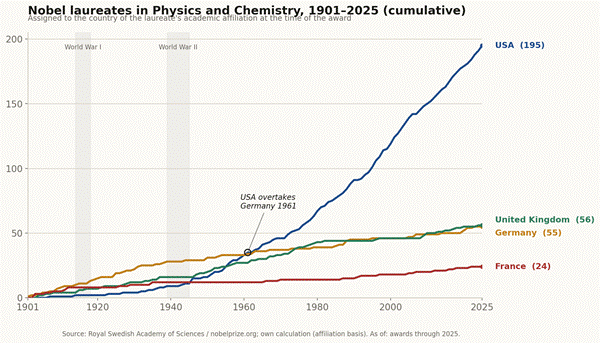
Figure 1: Cumulative Nobel laureates in Physics and Chemistry, 1901–2025 (affiliation basis). Source: nobelprize.org, own calculation.
First phase (1901 to about 1930): During the first three decades, Germany was the undisputed centre of the natural sciences. By around 1930, Germany had already accumulated some two dozen laureates, while the USA stood at a handful. The United Kingdom followed as a steady number two; France began strongly with the Curies and Becquerel, but then remained at a low level for a long time.
Second phase (1933 to 1945): With the expulsion and emigration of numerous scientists from 1933 onwards, the German curve flattens noticeably. Researchers such as Hans Bethe, Maria Goeppert-Mayer and Otto Stern won their awards only later — and already as scientists in the USA. The loss of personnel in those years still has an effect today.
Third phase (from about 1960): Around 1961 the USA overtakes Germany and then rises almost unchecked. As of the 2025 cut-off date, the final standing is as follows:
| Country | Physics | Chemistry | Total |
| USA | 110 | 85 | 195 |
| United Kingdom | 26 | 30 | 56 |
| Germany | 22 | 33 | 55 |
| France | 15 | 9 | 24 |
It is notable that Germany has maintained its tradition better in Chemistry (33 laureates) than in Physics (22), where the gap to the USA is particularly wide. Overall, with almost 200 laureates, the USA stands around three and a half times as high as Germany.
Methodological note: The assignment follows the affiliation as stated by the Nobel Foundation, i.e. the country in which the laureate was working at the time of the award. A count by country of birth would be higher for Germany and lower for the USA — precisely because of the wave of emigration. The 2026 prizes will not be announced until October 2026; the data reflect awards through 2025. Source: Royal Swedish Academy of Sciences / nobelprize.org.
2. The record of the last 20 years
Because Nobel Prizes honour work that often dates back decades, it is worth looking at the most recent window. In the years 2006 to 2025 too, the gap has not narrowed but solidified:
| Country | Physics | Chemistry | Total 2006–2025 |
| USA | 25 | 31 | 56 |
| United Kingdom | 5 | 5 | 10 |
| Germany | 4 | 4 | 8 |
| France | 4 | 1 | 5 |
In this period, the USA produced about seven times as many laureates as Germany. There were certainly German successes — Gerhard Ertl (Chemistry 2007), Stefan Hell (2014), Benjamin List (2021), Reinhard Genzel and Klaus Hasselmann (Physics 2020/2021) and Ferenc Krausz (2023) — but they remained isolated cases in a field dominated by US institutions. Tellingly, several of these prizes went to Max Planck Institutes: Germany’s leading research is concentrated in a few non-university flagships.
3. Research spending: USA and Germany compared
In absolute terms: a factor of around six
The most obvious explanation is research spending. According to estimates by the World Intellectual Property Organization (WIPO, purchasing-power-adjusted, base year 2015), in 2024 the USA invested around USD 782 billion in research and development — Germany around USD 132 billion. The OECD even puts US spending at the one-trillion-dollar mark in 2024 prices; only China is now on a par. In absolute terms, the USA therefore spends about six times as much on research and development as Germany.
Relative to population: ahead per capita as well
This factor of six could be explained in part by size: with around 340 million inhabitants, the USA has roughly four times as many people as Germany (about 84 million). The spending lead (≈ 6:1), however, exceeds the population lead (≈ 4:1). This means that the USA invests more even per capita. US per-capita spending in 2023 was around USD 2,850 (purchasing-power-adjusted); for Germany the figure works out at roughly USD 2,000 — so the USA is about a third higher per head.
Measured against economic output, Germany is almost level
If research intensity is measured as a share of gross domestic product, the gap shrinks considerably: in 2023/24 the USA reached around 3.45 per cent, Germany 3.11 to 3.14 per cent. Germany thus still belongs to the world’s leading group and ranks ahead among the large EU economies. The problem therefore lies less in the ratio than in the absolute scale and in structural factors — and increasingly in the direction of travel: in 2024, real research spending grew by 3.4 per cent in the USA, while it fell by 0.4 per cent in Germany. The gap is thus widening further.
4. The patent picture
For an IP location, patent statistics are informative, as they capture applied innovative strength more directly than the Nobel Prize. Here a more nuanced picture emerges.
In international PCT applications, Germany ranked fifth worldwide in 2024 with 16,721 filings — behind China (70,160), the USA (54,087), Japan (48,397) and South Korea (23,851; WIPO PCT Yearly Review 2025). In absolute terms, the USA files a good three times as many international patents as Germany. Per capita, however, the picture reverses: per million inhabitants, Germany reaches around 200 PCT applications, the USA only about 158. In applied, SME-driven engineering innovation — mechanical engineering, electrical engineering, drive technology, energy — Germany remains a patent powerhouse.
In research-intensive future fields, however, the warning signs are mounting:
- Pharmaceuticals: In 2000, more than 1,400 applications (around 17 per cent of the global sector) still came from Germany; by 2021 this figure had fallen to around 849 (German Economic Institute, IW).
- Clinical trials: In the number of clinical trials run by pharmaceutical companies, Germany slipped from second place (2016) to fourth — behind the USA, China and Spain.
- Translation gap: The path from basic research to marketable, protectable products is regarded as a chronic weakness of the location.
Germany thus defends its position where it has traditionally been strong, but is losing ground in precisely those fields where the scientific and economic returns of the future arise — and where the next Nobel Prizes will be awarded.
5. Structural causes
Why, despite a high research ratio, does Germany fail to close the gap with the world’s leaders? The Commission of Experts for Research and Innovation (EFI), together with position papers by the Stifterverband, the Leopoldina and the Volkswagen Foundation, identify a structural rather than a cyclical problem:
- Bureaucracy and administrative burden. Cumbersome, slow approval and immigration procedures deter international top talent.
- Talent balance at the top end. Germany has recently recorded a net inflow of researchers; the scientists who leave, however, are on average more prolific in publications than those newly arriving.
- Demographics. Like the economy as a whole, the science system is affected by ageing-related personnel shortages and is increasingly dependent on immigration.
- Economies of scale and magnetism. Leading US universities and companies concentrate money, talent and venture capital at a self-reinforcing density: excellence attracts excellence.
- Infrastructure for future technologies. According to the European Commission, the entire EU has less than 5 per cent of the world’s AI computing capacity — the USA around 75 per cent, China 15 per cent (German Bundestag, printed paper 21/3357, 2025).
6. Outlook: trend and forecast
Risk scenario
If the current path continues, the gap to the USA is likely to widen further. The indicators: falling real research spending in 2024, a clear lag in AI computing capacity, the retreat from pharmaceutical frontier research and a demographically driven worsening of the skills shortage. With the Nobel Prize, which rewards breakthroughs with decades of lead time, this weakness will only fully show in the 2040s — but the seeds are being sown today. The most likely forecast: Germany continues to fall behind at the scientific frontier.
Opportunity scenario
At the same time, US research budgets are coming under pressure under the second Trump administration. German voices see this as an opportunity to attract top researchers to Europe. There are also real strengths that often get lost in the crisis rhetoric: in the Nature Index 2025, Germany ranks third worldwide behind China and the USA, and first in Europe; the research landscape (Max Planck, Fraunhofer, Helmholtz, Leibniz) is highly differentiated, and research intensity, at over 3 per cent of GDP, is in the upper field of industrialised nations. Whether Germany seizes this opportunity depends less on money than on the speed of reform: leaner bureaucracy, a genuine culture of welcome with financial incentives for top talent, investment in computing infrastructure, more venture capital and the closing of the translation gap.
7. Conclusion for IP practice
The 125-year Nobel record is a lagging indicator of the shift in scientific gravity. Germany has lost its former leading role to the USA and has been unable to narrow the gap over the past two decades either — if anything, the gap is still widening. For clients and IP strategists, this means:
- Frontier research is shifting. Anyone seeking to build IP rights in key technologies (AI, biotechnology, quantum, semiconductors) must keep an eye on the US and Chinese markets and their filing dynamics.
- Germany’s strength remains applied innovation. In SME-driven engineering innovation, Germany’s per-capita patent density is world-leading — and for many clients that is where the greatest value lies.
- Locational competition is becoming tougher. Structural weaknesses — bureaucracy, the translation gap, infrastructure — determine whether excellent basic research becomes protectable, marketable inventions.
Germany is not falling behind because it does too little research, but because others scale faster, larger and more purposefully — and because the path from idea to IP right is too long here. It is precisely at this interface between research and industrial property rights that it will be decided whether the next generation of breakthroughs bears a German return address.
Data sources: Royal Swedish Academy of Sciences / nobelprize.org; OECD Main Science and Technology Indicators (2026); WIPO Global Innovation Index (2025) and PCT Yearly Review (2025); Eurostat (2024); SSTI (2025); Commission of Experts for Research and Innovation; Stifterverband / Leopoldina / Volkswagen Foundation (2025); German Bundestag, printed paper 21/3357 (2025); Nature Index (2025). Own calculations for the cumulative Nobel count (affiliation basis).


