Anyone who dockets Hong Kong standard patents like European patents will get the dates wrong. Hong Kong charges two different kinds of annual fee: a maintenance fee for certain pending applications and a renewal fee for granted patents. Neither is simply due on each anniversary of the filing date from the third year onwards. Above all, the grant itself resets the clock: after grant, there are no fees at all for about three years.
This article explains when each fee falls due, how the two differ, and how the dates work out in three typical cases.
Two Routes to a Standard Patent
A Hong Kong standard patent can be obtained in two ways, and the fee rules depend on which one is used.
Standard patent (R) – re-registration: The patent is based on a “designated patent application” at the CNIPA, the EPO (for a European patent designating the United Kingdom) or the UK Intellectual Property Office. Stage 1 is the request to record, filed within 6 months after publication of the designated application. Stage 2 is the request for registration and grant, filed within 6 months after grant of the designated patent (IPD: FAQ Standard patent (R)). The term is 20 years from the filing date of the designated application.
Standard patent (O) – original grant: Since December 19, 2019, an application can be filed directly in Hong Kong and is examined by the Intellectual Property Department (IPD) itself. The term is 20 years from the Hong Kong filing date (IPD: FAQ Standard patent (O)).
Maintenance Fees: Only for Pending (R) Applications
A maintenance fee keeps a pending standard patent (R) application alive. It is paid with Form P9. According to the IPD, it is due “before the expiry of the fifth or any succeeding year” from the anniversary of the filing date of the designated application “first occurring after the date of publication of the request to record” (IPD: Maintenance and Renewal). After that, it is due on every anniversary until the patent is granted. If it is not paid, the application is deemed withdrawn.
The anchor date is therefore not the Hong Kong filing date and not the publication date, but the filing date of the Chinese, European or British application. The five years only start to run at the first anniversary after the request to record has been published. In practice, maintenance fees arise only when the designated application is still pending about seven to eight years after its filing date, for example after a long European examination or a Chinese re-examination.
Applications for a standard patent (O) do not require maintenance fees, however long examination takes.
Renewal Fees: Only for Granted Patents
A renewal fee keeps a granted standard patent, (R) or (O), in force. It is paid with Form P10. According to the IPD, the first renewal fee is due on “the fourth anniversary of the date of filing” “following the date of grant” (IPD: Maintenance and Renewal). This means the fourth anniversary of the filing date that falls after the grant, not the fourth anniversary after filing. For a standard patent (R), the filing date of the designated application counts; for a standard patent (O), the Hong Kong filing date. After that, the renewal fee is due on every anniversary until the 20-year term ends.
The consequence is a fee-free period of roughly three years after grant: the first three anniversaries after grant cost nothing.
Rules Common to Both Fees
Earliest payment: up to 3 months before the due date.
Grace period: 6 months after the due date, with a late fee.
Non-business days: a time limit that expires on a day that is not a business day is extended to the next business day.
(R): filing date of the designated application; (O): Hong Kong filing date
First due
End of the 5th year from the first anniversary after publication of the request to record
4th anniversary of the filing date after grant
Then
Every anniversary until grant
Every anniversary until the end of the 20-year term
If not paid
Application deemed withdrawn
Patent ceases to have effect
Three Examples
Example 1: Standard patent (R) based on a long-pending Chinese application. The Chinese application was filed on March 10, 2020 and published in September 2021. The request to record was published in Hong Kong on May 20, 2022. The Chinese patent is granted in January 2029, the Hong Kong patent on June 12, 2029.
Date
Event
Fee
March 10, 2023
First anniversary of the Chinese filing date after publication of the request to record
None; the five years start here
March 10, 2028
Expiry of the 5th year; application still pending
First maintenance fee (payable from December 10, 2027; grace period until September 10, 2028)
March 10, 2029
Application still pending
Second maintenance fee
June 12, 2029
Grant of the Hong Kong patent
Maintenance fees end
March 10, 2030 to March 10, 2032
First to third anniversary after grant
None
March 10, 2033
Fourth anniversary after grant
First renewal fee, then every year until 10 March 2040
Example 2: Standard patent (R) based on a European application with normal pendency. The European application was filed on September 5, 2019 and granted in October 2022. The Hong Kong patent was granted on April 20, 2023. The first maintenance fee would only have been due on September 5, 2027 (five years after September 5, 2022, the first anniversary after publication of the request to record in October 2021). Because the patent was granted earlier, no maintenance fee is payable. The anniversaries in 2023, 2024 and 2025 are free. The first renewal fee falls due on 5 September 2026, payable from June 5, 2026, with a grace period until March 5, 2027.
Example 3: Standard patent (O). The application was filed in Hong Kong on February 3, 2021 and granted on August 18, 2024. No fees were payable during the three and a half years of examination. The anniversaries in 2025, 2026 and 2027 are free as well. The first renewal fee falls due on February 3, 2028, payable from November 3, 2027, with a grace period until August 3, 2028.
Ireland has no utility model. Instead, it offers two national patents side by side: a full-term patent with a maximum term of 20 years and a short-term patent with a maximum term of 10 years. The short-term patent is granted without search or substantive examination. Full-term applications filed after May 19, 2017 are examined substantively again, but with a twist: the applicant must actively supply “evidence of novelty”.
Interest in the Irish national route is growing. According to the IPOI Annual Report 2024, national patent filings rose by more than 31 % to 774 applications, mainly because of applicants from China. Of these, 642 were short-term and only 132 full-term applications. Over the same period, pending applications rose by 62 % to 1,260.
This article summarises the particularities of the Irish grant procedure, the official fees, the realistic duration and the alternatives via the European patent and the PCT.
Two Types of Patent: Full-Term and Short-Term
The choice between the two types decides the term, the claim set, the examination and the court in which the patent can later be enforced (IPOI: Types of Patents).
Full-term patent
Short-term patent
Maximum term
20 years
10 years
Number of claims
No limit
Max. 5 claims
Patentability
Novelty, inventive step, industrial applicability
Novelty, industrial applicability, “not clearly lacking an inventive step”
Search before grant
Evidence of novelty required
Not required
Substantive examination
Yes (applications filed after 19 May 2017)
No
Official fees
Full rate
50 % of the full-term filing, grant and renewal fees
Infringement proceedings
High Court
Circuit Court or High Court
The short-term patent comes close to a utility model, but with one important catch. Before suing an infringer, the proprietor must either request a search report from the Controller or, where a foreign search report exists, supply copies to the Controller and to the alleged infringer. The Controller publishes these reports. A third party with a legitimate business interest may also request a search report on a short-term patent.
Both types can be filed for the same invention. However, the short-term patent becomes void once the full-term patent is granted. A short-term patent can therefore bridge the period until a full-term patent is granted, but it does not add a second layer of protection.
The Full-Term Patent: Evidence of Novelty Within 21 Months
The full-term patent is not searched automatically. Within 21 months from the filing date or, if priority is claimed, from the priority date, the applicant must take one of two routes (IPOI: Search Report / Evidence of Novelty). If neither is chosen in time, the application is refused.
Irish search report: The applicant requests a search report and written opinion from the IPOI. The official fee is EUR 200. The report is published unless the application is withdrawn within two months of its issue.
Foreign search results: The applicant declares that evidence of novelty will be furnished from a corresponding application at the European Patent Office, the UK Intellectual Property Office or the German Patent and Trade Mark Office, or under the PCT. The evidence is a copy of the foreign search report and written opinion, or of the patent granted by one of these three offices. It must be filed within two months of the publication of the foreign report or of the grant; the official fee is EUR 86.
On either route, the applicant must then amend the application in the light of the search results or state that no amendment is necessary. The application is then examined substantively for novelty, inventive step and industrial applicability. This examination was reintroduced for applications filed after May 19, 2017; before that date, Irish full-term patents were granted without substantive examination.
For applicants who also file a European application, the second route is attractive. The European search report can be reused in Ireland, which saves the Irish search fee and avoids two diverging search results for the same invention.
Formal Requirements, Language and Representation
The application is filed in English or Irish, so for most foreign applicants no translation is needed. A filing date only requires an indication that a patent is sought, information identifying the applicant and a description. Claims and abstract can follow within 12 months from the filing or priority date. Drawings filed later, however, shift the filing date (IPOI: Guide to the application form).
The main formal deadlines run from the earliest priority date:
Statement of inventorship: within 16 months, if the applicant is not the sole inventor, for example a company. The statement explains how the applicant derived the right from the inventors, for instance through an employment contract or an assignment. If it is missing, the application is refused (IPOI: Statement of Inventorship).
Publication: about 18 months after the filing or priority date.
English translation of a non-English priority document: within 21 months. For a Chinese priority application, the Irish application text is usually the translation already.
Applicants without a residence or principal place of business in the European Economic Area must be represented by a patent agent (IPOI: Patents for Inventions). The agent needs an authorisation (Form No. 5) signed by the applicant. Patent attorneys qualified in another EU member state, such as German patent attorneys, may act directly before the IPOI under Section 106(3A) of the Patents Act 1992. Before acting for the first time, they notify the Controller and submit evidence of their establishment, qualification and nationality (Points of Single Contact Ireland). The address for service may be anywhere in the EEA.
Official Fees
The Irish official fees are low by European standards. Keeping a full-term patent in force for the full 20 years costs about EUR 5,000 in official fees in total, a short-term patent for 10 years about EUR 660 (IPOI: Patent Schedule of Fees).
Official fee
Full-term patent (EUR)
Short-term patent (EUR)
Filing fee
125
60
Search report and written opinion by the IPOI
200
Only before enforcement: 200
Evidence of novelty (foreign search results)
86
–
Grant fee
64
30
Renewal fee, 3rd year
60
30
Renewal fee, 5th year
114
57
Renewal fee, 10th year
220
110
Renewal fee, 20th year
468
–
Renewal fees in total
4,628 (years 3 to 20)
569 (years 3 to 10)
Renewal fees are due from the third year onwards, already while the application is pending. The fees for the short-term patent are half of those for the full-term patent. The search fee of EUR 200 for a search report and written opinion has applied to applications filed since May 19, 2017 (S.I. No. 205/2017).
Duration of the Grant Procedure
A short-term patent is typically granted within 12 to 18 months; a full-term patent usually takes two to three years. The IPOI publishes service targets and its results in its Annual Report 2024:
Procedure step
IPOI target
Achieved in 2024
Grant of a short-term patent
80 % within 12 months of filing
69 %
Grant of a short-term patent
100 % within 18 months of filing
88.5 %
Substantive examination of a full-term application
75 % within 12 months of receipt in the examination section
62 %
Substantive examination of a full-term application
90 % within 18 months of receipt in the examination section
67 %
For the full-term patent, the clock for examination only starts once the evidence of novelty is on file, which can take up to 21 months from the priority date. An applicant who requests the Irish search report at filing therefore gets a patent considerably faster than one who waits for a European search report or a European grant. At the end of 2024, 386 applications were waiting for evidence of novelty. The average time from filing to grant may be put to at three years.
All four targets were missed in 2024. In the same year, the number of pending applications rose sharply, which the IPOI attributes to the rise in applications from China.
Alternatives: The European Patent and the PCT Conversion Route
European patent. A European patent granted in English takes effect in Ireland without a translation, because Ireland is a party to the London Agreement. Renewal fees are then paid in Ireland. A Unitary Patent, however, does not cover Ireland. Ireland signed the UPC Agreement more than ten years ago but has not ratified it; the required referendum, planned for June 2024, was postponed, and as of September 2025 no new date had been set.
PCT conversion. The national PCT route to Ireland is closed: a PCT application designating Ireland is treated as a European application. Since the Copyright and Other Intellectual Property Law Provisions Act 2019, however, Section 127A of the Patents Act 1992 allows the applicant to request that a PCT application designating Ireland be treated as an Irish national application. The request must be filed no later than 31 months from the filing or priority date, whichever is earlier (IPOI practice note of January 26, 2021). Three points deserve attention:
The conversion leads only to a full-term patent; a short-term patent cannot be requested this way.
The request cannot be filed through the IPOI’s online system; it must be submitted by post or another permitted channel.
The Euro-PCT application may continue in parallel. If a European patent designating Ireland is later granted, the Controller may revoke the Irish patent to avoid double protection.
An Irish patent obtained this way, based on evidence of novelty, is usually granted within 12 to 18 months of entering the national phase.
Conclusion for IP Practice
Two patents, two purposes. The short-term patent is fast and cheap but limited to five claims and must be backed by a search report before it can be enforced. The full-term patent is examined and lasts up to 20 years.
Evidence of novelty is the critical deadline. Without a search request or a statement on foreign search results within 21 months from the priority date, the full-term application is refused. Reusing a European, British or German search report saves cost.
No translation of the application. The application is filed in English; only a non-English priority document must be translated within 21 months.
Watch the 16-month deadlines. The certified copy of the priority document and the statement of inventorship are both due 16 months from the priority date.
EU patent attorneys can act directly. A national patent attorney can represent foreign applicants before the IPOI after notifying the Controller once.
Low fees, longer waits. About EUR 5,000 in official fees covers a full 20-year term, but the backlog has grown with the surge in applications from China.
PCT applicants have a second door. Under Section 127A, a PCT application designating Ireland can be converted into an Irish full-term application within 31 months.
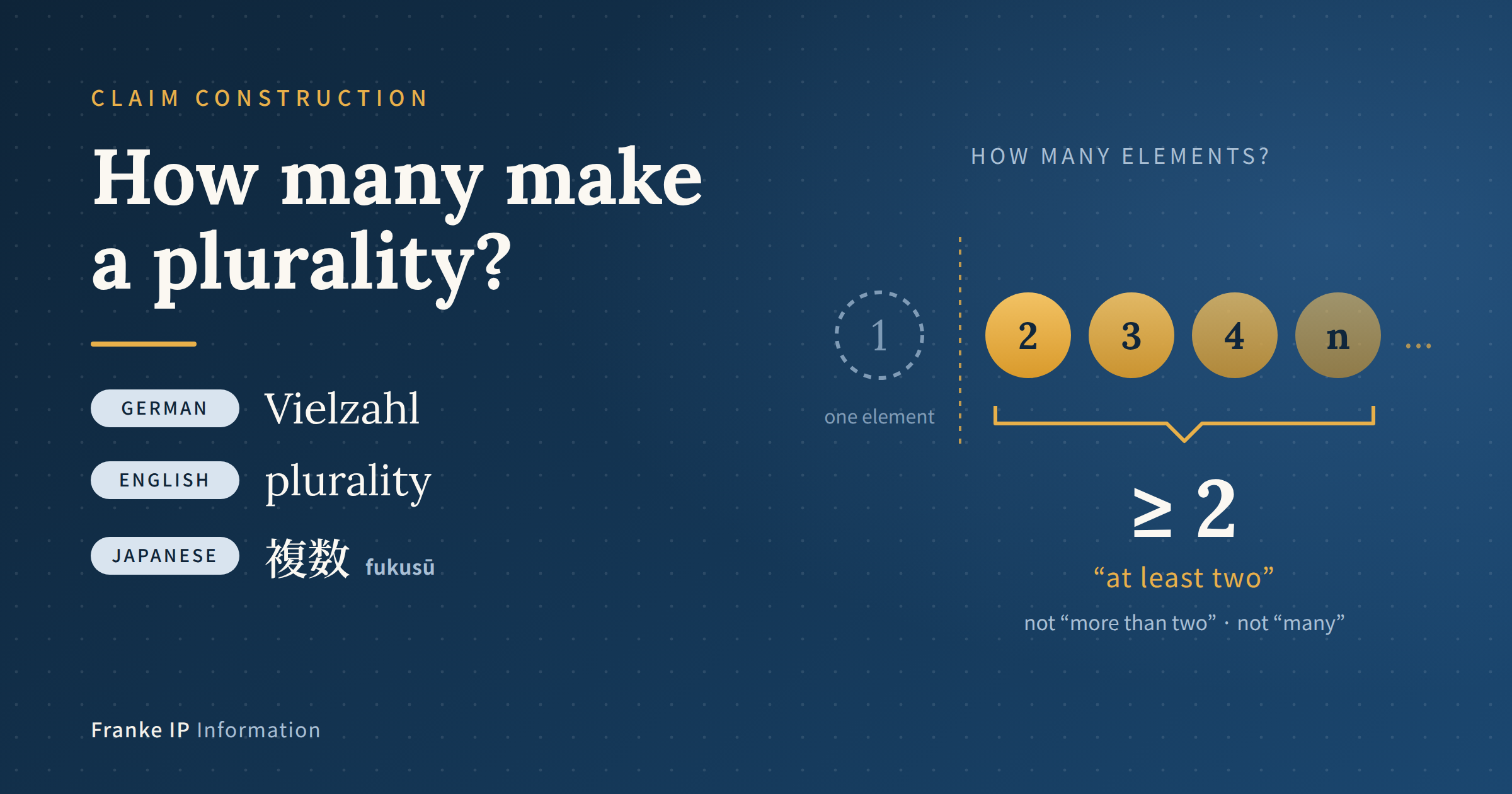
“Plurality” is one of the most common words in patent claims. German claims say “Vielzahl”, Japanese claims “複数” (fukusū). Yet infringement proceedings keep returning to the same question: how many elements make a plurality? Are two enough, must there be more than two, or does the word even imply a “large number”? We have reviewed the case law in Germany, before the Unified Patent Court (UPC), at the European Patent Office (EPO), in the United States and in Japan.
The short answer: As far as we can see, “Vielzahl”, “plurality” and “複数” mean “at least two” in every jurisdiction reviewed. That is “more than one”, not “more than two”, and certainly not “many”.
Deviating readings do occur, mostly as a defence argument. They have required at least three, or even more than three, elements. None of them prevailed in the decisions we reviewed. The term is still treacherous elsewhere: in lists, in the relationship between singular and plural, and in translation.
I. The starting point: “Vielzahl” is linguistically ambiguous
In everyday German, “Vielzahl” suggests a large quantity. Someone who speaks of a “Vielzahl von Beschwerden” (a multitude of complaints) rarely means exactly two. The English “plurality” is more sober and initially denotes nothing more than the state of being plural. The Japanese “複数” is the grammatical counterpart of “単数” (singular) and means “two or more”.
Claim construction, however, does not turn on everyday usage. What matters is how the skilled person understands the term against the background of the patent specification. The question is therefore whether courts treat “plurality” as a term of art in patent language, and whether they have ever arrived at a minimum number other than two.
II. Germany
1. Principles
According to settled case law of the Federal Court of Justice (BGH), a patent claim is to be construed from the perspective of the skilled person. The description and drawings must be taken into account, and the patent specification may serve as its “own dictionary”. A term can therefore have a meaning in the patent that differs from ordinary usage. This also applies to terms of quantity.
2. Case law on “Vielzahl”
The Düsseldorf patent chambers regularly construe “Vielzahl” as “at least two” without much discussion:
Düsseldorf Regional Court, judgment of 12 December 2018 – 4b O 15/17: The claim concerned a “multiple decoding step” using a “Vielzahl von Dekodierungsverfahren” (plurality of decoding methods). The chamber held that “multiple” or “plurality” means “at least two” in this context. Two different decoding methods in the standard at issue were sufficient.
Düsseldorf Regional Court, judgment of 24 April 2012 – 4b O 274/10: According to this decision, a “Vielzahl von Nutzerklassen” (plurality of user classes) requires a network in which “several”, i.e. at least two, user classes are distinguished.
Düsseldorf Regional Court, judgment of 8 August 2019 – 4c O 88/17: A “Vielzahl von Probenverarbeitungs-Modulen” (plurality of sample processing modules) requires at least two modules. The chamber also derived this from the function: the claimed coordination only makes sense where there are several modules.
What is missing is also telling. In numerous other infringement cases the claim contained a “Vielzahl” without the parties raising the term at all. Examples are Düsseldorf Higher Regional Court, 2 U 72/23 (“plurality of cutting edges”), and Düsseldorf Higher Regional Court, 2 U 138/22 (“plurality of … dispensing mechanisms”). We found no published decision in which a German court considered “Vielzahl” unclear or required a minimum of more than two.
3. The reverse case: the plural as a generic term
In Germany, the deviation tends to go in the opposite direction. The Karlsruhe Higher Regional Court (judgment of 28 February 2024 – 6 U 161/22, “Magnetsteuerventil”) held that a plural used in a claim (“verbindende Wasserleitungen”, connecting water lines) can be understood as a generic designation. In that case a single element suffices. This applies at least where the patent as a whole does not show that at least two must be present.
For “Vielzahl” this argument is considerably harder to make. Unlike a mere plural, the word expressly denotes a number. The decision nevertheless shows that German courts always read quantities in the context of the patent specification and not purely grammatically.
III. Unified Patent Court
The UPC construes claims according to the principles set out by the Court of Appeal in NanoString v 10x Genomics (order of 26 February 2024). The claim is the decisive basis, and the description and drawings must always be used as explanatory aids. The first decisions on terms of quantity are now available:
Local Division Düsseldorf, decision of 10 October 2024 – UPC_CFI_363/2023 (Seoul Viosys v expert): The claim required “mesa-etched regions” in the plural. The division held that this means at least two such regions.
Local Division Milan, decision of 21 April 2026 – UPC_CFI_472/2024 et al. (Dainese v Alpinestars): The defendants argued that the claim did not require a “plurality of housings”. Elsewhere it referred to “one or more inner housings”, they said, and this contradiction made the (amended) claim unclear. The division disagreed. The skilled person would recognise that a plurality of housings is necessary for the invention to work, and all figures showed this structure. The patent was upheld and infringement was found.
The Milan case illustrates a typical risk. Using both “one or more” and “plurality” for the same element creates a point of attack. The courts resolve such tensions functionally, but not necessarily in the patentee’s favour.
IV. European Patent Office and United Kingdom
Following the Enlarged Board of Appeal’s decision G 1/24 (18 June 2025), the description and drawings must always be consulted when interpreting the claims, including when assessing patentability. The EPO has thereby moved closer to the UPC standard. For “plurality” this means that the EPO, too, reads the term in the light of the description. The description can therefore also define it with binding effect.
We found no Board of Appeal decision giving “plurality” a meaning other than “at least two” or objecting to the term as unclear under Art. 84 EPC. The same applies to the courts of England and Wales. They construe claims purposively and apply the equivalents approach of Actavis v Eli Lilly (UKSC 2017). Neither principle gives any reason to read in a “large number”.
V. United States
The position is clearest in the US, because the Federal Circuit has construed the term expressly on several occasions. This is also where the most striking examples of deviating readings can be found.
1. “Plurality” means “at least two”
York Products v. Central Tractor Farm & Family Center, 99 F.3d 1568 (Fed. Cir. 1996): The district court had construed “plurality” as more than three gaps or pockets on each sidewall. The Federal Circuit reversed. The term means simply “the state of being plural” and therefore requires only at least two ridge members on each sidewall.
Dayco Products v. Total Containment, 258 F.3d 1317 (Fed. Cir. 2001): The defendant argued that “plurality” required three or more projections. The court held instead that “plurality”, when used in a claim, refers to two or more items, “absent some indication to the contrary”.
Callpod v. GN Netcom (N.D. Ill., 6 March 2009): The defendants argued that a “plurality of participants” in a conference call required at least three participants, because a conference presupposes more than two people. The court rejected this and held to “more than one”.
The phrase “absent some indication to the contrary” matters. In the US, too, “at least two” is only the default meaning. A different definition in the description or an unambiguous context may lead to another result.
2. Where “plurality” really does work differently
Lists – SIMO Holdings v. Hong Kong uCloudlink, 983 F.3d 1367 (Fed. Cir. 2021): The claim required “a plurality of memory, processors, programs, communication circuitry, authentication data … and non-local calls database”. The Federal Circuit applied “a plurality of” to each item in the list, so that at least two of every item had to be present. Because the accused product lacked two databases, infringement was denied and a jury verdict of around USD 8 million was reversed. This is the most consequential “different meaning” of “plurality” in practice, although it concerns the reach of the term rather than the minimum number.
Parts of a whole – August Technology v. Camtek (Fed. Cir. 2011): A “plurality of wafers” cannot be satisfied by counting sections of a single wafer as several wafers. The claim deliberately distinguished between “wafer” and “wafers”.
A plural is not “one or more” – Apple v. MPH Technologies (Fed. Cir., 9 March 2022): Apple sought to read the plural “information fields” as “one or more”. The Federal Circuit required more than one field.
3. The counterpart: the indefinite article
Conversely, under US law the indefinite article “a” in open (“comprising”) claims generally means “one or more” (KCJ Corp. v. Kinetic Concepts, 2000). In Salazar v. AT&T Mobility (Fed. Cir., 5 April 2023), the Federal Circuit confirmed this rule but refined it. Where several functions are assigned to “said microprocessor”, at least one microprocessor must be capable of performing all of them. Spreading the functions across different processors is not enough.
VI. Japan
Under Art. 70(1) of the Japanese Patent Act, the technical scope of a patented invention is determined by the claims. Under Art. 70(2), the meaning of claim terms is to be interpreted in the light of the description and drawings. The courts also take into account the prosecution history, the prior art and common general knowledge.
“複数” means “two or more”, both linguistically and in patent practice. Japanese commentators regard the term as unproblematic for precisely this reason: writing “複数の” covers every case from two upwards, leaving no room for dispute. We found no published decision in which a Japanese court gave “複数” a different meaning. This is subject to the caveat that the Japanese case-law database was only partly searchable for us.
Indefinite quantity words are a different matter. The Japan Patent Office documents decisions in which expressions such as “わずかに” (slightly) or “適度に” (moderately) were held unclear where the description provided no yardstick. Practitioners therefore advise using the neutral “複数” rather than the evaluative “多数” (many, a large number).
The real risk in Japan lies in translation. Japanese nouns have no grammatical number. Without an additional marker, the Japanese text barely reveals whether an English claim said “a tank” or “tanks”. “One or more” or “at least one” should therefore be rendered expressly as “1つ以上の” or “少なくとも1つの”, and “a plurality of” as “複数の”.
A note on China: How seriously questions of number are taken in Asia is shown by a decision of the Supreme People’s Court of 13 November 2014 ((2014) Min Ti Zi No. 497, Free Motion Fitness). There, the express singular “one cable” was limited to exactly one cable despite the open wording of the claim.
VII. Overview
Jurisdiction
Default meaning
Deviating approaches
Outcome
Germany
“Vielzahl” = at least two
A plural can, as a generic term, cover a single element (OLG Karlsruhe 2024)
No decision found requiring more than two or finding the term unclear
UPC
Plural = at least two
Objection that “one or more” contradicts “plurality” (LD Milan 2026)
Objection rejected; functional construction
EPO / UK
At least two; no deviating case law found (EPO: construction with the description under G 1/24)
—
No deviating decision found
US
“two or more … absent some indication to the contrary”
“More than three” (district court in York), “three or more” (defendants in Dayco, Callpod); applies to each list item (SIMO)
Minimum of two settled; SIMO narrows scope for lists
Japan
“複数” = two or more
—
No deviating decision found; risk lies in translation
VIII. Drafting recommendations
Define the term. One sentence in the description rules out the debate, for example: “For the purposes of this application, a plurality means a number of at least two.” (In German: „Unter einer Vielzahl bzw. mehreren wird im Sinne dieser Anmeldung eine Anzahl von mindestens zwei verstanden.“) Since G 1/24 and the UPC case law require the description always to be consulted, such a definition is effective both before the EPO and in infringement proceedings.
Take care with lists. “A plurality of A, B and C” may be read as “at least two A, two B and two C” (SIMO). If only A is to be present more than once, “a plurality of A; a B; and a C” is the safe wording.
Do not mix. Do not use “one or more” and “plurality” for the same element (cf. LD Milan).
If one element is enough, say so. Write “at least one”, “one or more” or “1つ以上の”. Do not rely on the German case law on generic plurals.
If more than two are needed, say that too. If the function requires at least three elements, “at least three” belongs in the claim. Courts do not derive a higher minimum from “plurality” alone.
Check translations. In Japanese and Chinese, number must be stated expressly. Avoid evaluative quantity words such as “多数” (“many”).
IX. Conclusion
“Vielzahl”, “plurality” and “複数” mean “at least two” in Germany, before the UPC, in the US and in Japan, not “more than two”. No deviating case law is apparent for the EPO or the United Kingdom.
Readings requiring at least three, or more than three, elements appear mainly as defence arguments. They did not prevail in the decisions reviewed. The clearest correction was of the district court in York Products, which had required “more than three”.
We found no decision holding “Vielzahl” or “plurality” to be unclear.
The real risks lie elsewhere: in lists (SIMO), in the relationship between singular, plural and “one or more”, and in translation into languages without grammatical number.
A short definition in the description costs nothing and takes an argument away from the other side.
Research status: September 2026. This overview is based on freely accessible decisions and publications. Subscription databases were not searched.
Sources
Düsseldorf Regional Court (LG Düsseldorf), judgment of 12 December 2018 – 4b O 15/17, NRWE
Düsseldorf Regional Court, judgment of 24 April 2012 – 4b O 274/10, NRWE
Düsseldorf Regional Court, judgment of 8 August 2019 – 4c O 88/17, NRWE
Düsseldorf Higher Regional Court (OLG Düsseldorf), judgment of 4 April 2024 – 2 U 72/23, NRWE; judgment of 23 November 2023 – 2 U 138/22, NRWE
Karlsruhe Higher Regional Court (OLG Karlsruhe), judgment of 28 February 2024 – 6 U 161/22 (Magnetsteuerventil), commentary: CBH Rechtsanwälte (German)
UPC, Local Division Düsseldorf, decision of 10 October 2024 – UPC_CFI_363/2023 (Seoul Viosys v expert), UPC
UPC, Local Division Milan, decision of 21 April 2026 – UPC_CFI_472/2024 et al. (Dainese v Alpinestars), UPC
EPO, Enlarged Board of Appeal, G 1/24 of 18 June 2025, overview: J A Kemp
York Products v. Central Tractor Farm & Family Center, 99 F.3d 1568 (Fed. Cir. 1996), FindLaw
Dayco Products v. Total Containment, 258 F.3d 1317 (Fed. Cir. 2001), CourtListener
As long as the European application is pending before the EPO, a single clear rule applies. On grant, that clarity fragments into 39 national regimes — and they diverge on precisely the point most easily overlooked in docketing: the due date itself.
The starting point: Rule 51(1) EPC as a deceptive habit
For the European patent application the position is unambiguous. Under Rule 51(1) EPC, a renewal fee falls due “on the last day of the month containing the anniversary of the date of filing of the European patent application”. A filing date of 9 October means a due date of 31 October. Where the filing date falls on 31 May, the due date remains 31 May. The renewal fee for the third year is the first payable (Art. 86(1) EPC) and falls due on the last day of the month containing the second anniversary of filing.
The rule is generous: on average it hands the applicant a little over two weeks. And that is exactly where the trap lies. Anyone who has worked to the end of the month for years tends to carry that habit unexamined into the national phases after grant — and is wrong in roughly a third of the contracting states.
The break at grant: Art. 141 EPC
The obligation to pay renewal fees to the EPO terminates with the payment of the fee due for the year in which the mention of grant is published (Art. 86(2) EPC). Under Art. 141 EPC, national renewal fees may only be imposed for the years following that year. From that moment national law governs exclusively — including the national due date rule, the national period of grace and the national surcharge.
The European bundle patent is therefore also a bundle of deadlines. Validate in ten states and, from grant onwards, you are administering ten deadlines which all derive from the same filing date but do not all fall on the same day.
Group 1: due on the last day of the month of filing
The majority of contracting states follow the pattern of Rule 51(1) EPC. On the sources reviewed, these are:
Albania, Austria, Belgium, Denmark, Estonia, Finland, France, Germany, Greece, Iceland, Ireland, Italy, Latvia, Liechtenstein, Luxembourg, Malta, Monaco, the Netherlands, Norway, San Marino, Spain, Sweden, Switzerland and the United Kingdom.
For Germany this follows directly from § 3(2) PatKostG: the renewal fee falls due “on expiry of the month whose designation corresponds to the month into which the filing date falls”. Austria applies the same approach, the Austrian Patent Office expressly referring to the last day of the month of filing. For France the same result follows from Art. R613-46 CPI; for Switzerland and Liechtenstein from the common territory of protection under the Patent Protection Treaty.
What is striking about this group is how heterogeneous it is. It contains both the classic high-volume validation states and micro-states such as Monaco and San Marino. There is no geographic or legal-family pattern to fall back on.
Group 2: due on the anniversary of the filing date
The second group works to the calendar anniversary — so the deadline expires, on average, a good two weeks earlier than in Group 1. On the sources reviewed, these are:
Bulgaria, Croatia, the Czech Republic, Hungary, Montenegro, North Macedonia, Poland, Portugal, Romania, Serbia, Slovakia, Slovenia and Türkiye.
For Montenegro this follows directly from the statute: Art. 81(2) of the Montenegrin Law on Patents (Official Gazette No. 42/2015, 2/2017, 146/2021, 3/2023) provides that the fees are payable for the third year and each subsequent year and “shall be due on the anniversary of the date of filing of the application”. Art. 81(4) grants an additional period of six months against payment of a surcharge.
The concentration in Central, Eastern and South-Eastern Europe is notable. Portugal and Türkiye are the outliers, to the west and south-east respectively. A portfolio validated predominantly in Western Europe encounters this group rarely — and is caught out by it all the more reliably as soon as a Polish or Czech validation is added.
Two cases that fit neither group
Cyprus. Cyprus has no due date in the continental sense at all. Rule 41(1)(a) of the Patent Regulations of 1998 does not fix a date on which the fee becomes due; it fixes a window within which it must be paid: Form P.13 together with the annual fee is to be filed “within three months before the expiration” of the current year of protection, counted from the filing date. For validated European patents this applies by analogy under Rule 55(1), the years being counted from the filing date of the European application (Rule 55(2)).
Two consequences follow. First, the payment period ends with the expiry of the current year of protection — and that is the day before the anniversary. A right filed on 1 February 2020 completed its first year of protection on 31 January 2021; the widely quoted “due the day before the anniversary” is therefore correct as a docketing date, but it describes the legal effect rather than the drafting technique. Second, there is a three-month payment window: payment cannot validly be made more than three months before the year of protection expires. Paying unusually far in advance risks not lateness but prematurity. The period of grace is six months against a surcharge (Rule 41(1)(b)).
Lithuania. Lithuania follows a different scheme altogether: the maintenance fee is payable within the final two months of the current year of protection, rather than on a date derived from the filing date. Secondary sources are inconsistent here; the Lithuanian Patent Law should be checked before the deadline is docketed.
A point of terminology
The commonly heard formulation that in certain states the renewal fee is payable “on the filing date” is misleading and should be kept out of docketing instructions. What is meant is always the anniversary of the filing date — the same calendar day in a later year. No EPC contracting state imposes a payment obligation on the filing date itself; the first renewal fee falls due at the earliest in the second, and usually in the third to fifth year of protection. The risk of confusion is not merely linguistic: writing “filing date” instead of “anniversary of the filing date” into a docketing instruction produces miscalculations as soon as the entry is processed automatically.
Overview: renewal fee due dates in the 39 EPC contracting states
Code
State
Renewal fee due date
AL
Albania
Last day of the month of filing
AT
Austria
Last day of the month of filing
BE
Belgium
Last day of the month of filing
BG
Bulgaria
Anniversary of the filing date
CH
Switzerland
Last day of the month of filing
CY
Cyprus
Before expiry of the current year of protection = day before the anniversary; three-month payment window (Rule 41(1)(a) Patent Regs 1998)
CZ
Czech Republic
Anniversary of the filing date
DE
Germany
Last day of the month of filing (§ 3(2) PatKostG)
DK
Denmark
Last day of the month of filing
EE
Estonia
Last day of the month of filing
ES
Spain
Last day of the month of filing
FI
Finland
Last day of the month of filing
FR
France
Last day of the month of filing (Art. R613-46 CPI)
GB
United Kingdom
Last day of the month of filing
GR
Greece
Last day of the month of filing
HR
Croatia
Anniversary of the filing date
HU
Hungary
Anniversary of the filing date
IE
Ireland
Last day of the month of filing
IS
Iceland
Last day of the month of filing
IT
Italy
Last day of the month of filing
LI
Liechtenstein
Last day of the month of filing (common territory with CH)
LT
Lithuania
Different scheme: final two months of the current year of protection — check separately
LU
Luxembourg
Last day of the month of filing
LV
Latvia
Last day of the month of filing
MC
Monaco
Last day of the month of filing
ME
Montenegro
Anniversary of the filing date (Art. 81(2) Law on Patents)
MK
North Macedonia
Anniversary of the filing date
MT
Malta
Last day of the month of filing
NL
Netherlands
Last day of the month of filing
NO
Norway
Last day of the month of filing
PL
Poland
Anniversary of the filing date
PT
Portugal
Anniversary of the filing date
RO
Romania
Anniversary of the filing date
RS
Serbia
Anniversary of the filing date
SE
Sweden
Last day of the month of filing
SI
Slovenia
Anniversary of the filing date
SK
Slovakia
Anniversary of the filing date
SM
San Marino
Last day of the month of filing
TR
Türkiye
Anniversary of the filing date
The practical consequence: work to the earlier date
One simple and robust working rule follows from this split — and it is the rule the CMS patent formalities guide for Europe recommends as well: after grant, docket to the anniversary of the filing date throughout, not to the end of the month. In the Group 1 states this forgoes an average of a little over two weeks — a price that does not begin to weigh against the risk of missing a due date in Group 2.
The single exception to this rule of thumb is Cyprus, where the preceding day already governs. Anyone with Cyprus in the portfolio must docket that deadline separately.
The special case: grant shortly after the anniversary
A distinct source of error arises where the mention of grant is published shortly after the anniversary of the filing date. In that constellation the first national renewal fee falls due in many states two months from the date of grant — potentially before the three-month validation period expires. Some states allow additional time for payment; by no means all do. In practice this means: if grant falls into that window, country selection for validation should be brought forward so that the first renewal fee does not slip into a surcharge-bearing grace period.
The second question: where must a national representative be appointed?
This question is often asked in the same breath as the due date question, but it operates on a different level and needs to be separated cleanly into three stages.
Stage 1 — proceedings before the EPO
Under Art. 133(2) EPC, natural and legal persons having neither their residence nor their principal place of business in an EPC contracting state must be represented by a professional representative (Art. 134 EPC) in all proceedings before the EPO, with the single exception of filing the European patent application. Legal persons having their seat in a contracting state may act through an employee under Art. 133(3) EPC. For parties established within the EPC territory there is therefore no compulsory representation before the EPO.
Stage 2 — validation and national proceedings
On grant, national procedural law takes over. The relevant connecting factor shifts: what matters is no longer establishment within the EPC territory, but as a rule establishment in the particular state or within the EEA.
For Germany this is governed by § 25 PatG: a person having neither residence, seat nor establishment in Germany may take part in proceedings before the DPMA and the Federal Patent Court, and may assert rights under the patent, only if they have appointed a lawyer (Rechtsanwalt) or patent attorney (Patentanwalt) as domestic representative. That representative is at the same time authorised to act in civil litigation concerning the patent. Parties established in Germany are under no such obligation.
A de facto obligation to instruct a local representative additionally exists wherever validation itself can only be effected through an admitted national representative. This applies in particular to the states requiring a full translation of the specification: Austria (unless granted in German), Bulgaria, Cyprus, the Czech Republic, Estonia, Greece, Italy, Poland, Portugal, Romania, San Marino, Serbia, Slovakia, Spain and Türkiye. In these states instructing a local representative is unavoidable in any event, irrespective of whether national law formally requires it. A second group requires translation of the claims only (including Albania, Croatia, Denmark, Finland, Hungary, Iceland, Latvia, Lithuania, Montenegro, the Netherlands, North Macedonia, Norway, Slovenia and Sweden); there too, filing through a local representative is the norm.
Art. 4 of the Montenegrin Law on Patents illustrates how finely national law can draw these lines. Foreign persons with no seat or residence in Montenegro must in principle be represented by a registered representative or a Montenegrin attorney (para. 1). Expressly permitted without a representative, however, are filing the application, submitting priority documents, paying fees, and receiving the associated communications (para. 2) — provided an address for the receipt of documents in Montenegro is supplied (para. 3). If neither is provided, the office issues an invitation to remedy within three months and otherwise rejects the submission (paras. 4 and 5). Para. 6 adds that the maintenance fee may be paid by any person in the name of the proprietor. Paying the renewal fee in Montenegro therefore requires no representative — but it does require an address for service.
Stage 3 — address for service
Even in those states where the European patent takes effect without translation and without any formal step — Belgium, France, Germany, Ireland, Luxembourg, Malta, Monaco, Switzerland/Liechtenstein and the United Kingdom — appointing a local address for service is advisable. Without one, communications from the national office may well not reach the proprietor, and that includes the reminder about an outstanding renewal fee or service of a revocation action. For Malta an address for service is effectively indispensable for proprietors from outside the EU; Switzerland and Liechtenstein require proof of an address in one of the two states.
Why this distinction matters: compulsory representation is not a mere formality but a liability issue. Where the domestic representative is missing, the proprietor cannot assert rights under the patent pursuant to § 25 PatG — the patent exists but is temporarily unenforceable. And where the address for service is missing, the national office’s fee reminder goes nowhere: the six-month period runs out without the proprietor ever learning of it.
Takeaways for practice
Before grant, Rule 51(1) EPC applies uniformly — due on the last day of the month of filing.
After grant that uniformity fragments. 24 contracting states stay with the end of the month, 13 work to the anniversary, and Cyprus to the day before it.
The safe working rule is to docket to the anniversary of the filing date throughout after grant, and separately to the preceding day for Cyprus.
“Due on the filing date” has no place in a docketing instruction. What is meant is the anniversary of the filing date; the confusion generates systematic errors once entries are processed automatically.
Compulsory representation is a three-stage question: Art. 133(2) EPC for EPO proceedings, national law after validation (in Germany § 25 PatG), and an address for service even in states with no validation formalities.
Anyone filing a European patent application that claims a German priority must supply the priority document — yet receives no confirmation from the EPO that it has arrived and been accepted. Since the DPMA joined WIPO DAS there has been an elegant way out. But it is neither automatic nor forgiving of mistakes. A critical assessment — with concrete practical guidance.
Among the inconspicuous but dangerous formalities in European patent proceedings is the priority document. Under Rule 53(1) EPC, an applicant claiming priority must file a certified copy of the previous application within 16 months of the earliest priority date claimed. If the document is not filed in time, the right of priority is at risk (Rule 59, Article 90(5) EPC). This sounds like routine — but it is not, once the document disappears into a “black hole” at the EPO.
No receipt, no certainty
The EPO does not positively confirm the substantive receipt of a subsequently filed priority document. Electronic filing does generate an automatic acknowledgement of receipt for the transmission of the files; however, there is no communication confirming that the document has actually been placed in the file and recognised as compliant with Rule 53. The applicant learns of a problem — if at all — only through an invitation under Rule 59 EPC, and that invitation may come late. In the worst case, the deficiency surfaces only during examination or even in opposition, when a cure is long since impossible and the priority — and with it, potentially, the validity of the patent — has been lost.
Progress with a catch: the DPMA joins WIPO DAS
For a long time this risk could not be avoided elegantly for German priorities, because German priority documents could not be exchanged electronically; the certified paper copy was mandatory. That has changed: since 25 November 2024, the DPMA participates in the WIPO Digital Access Service (DAS) as a “depositing Office” for patents and utility models. A German priority document can now be made available electronically in DAS and retrieved by the EPO — free of charge and without paper (whereas the certified paper copy is subject to a fee).
The catch lies in the procedure. The exchange is not automatic but request-based: the applicant must actively request the DPMA to make an electronic priority document available (form A 9164) and receives a confidential access code. That code must then be communicated to the second office — here the EPO — so that the EPO can retrieve the document from DAS. If either step is omitted, the document is not in DAS, and the certified paper copy — with the confirmation gap described above — remains the only option.
Why Germany remains a special case
To make matters worse, the EPO does not retrieve German priority documents of its own motion. For a number of offices the EPO obtains the document ex officio and without any action by the applicant — for European and EPO-filed PCT first filings, and, on the basis of established exchange arrangements, for Chinese, Korean and US first filings (Rule 53(2) EPC; Guidelines A-III, 6.7). Germany is not on this list for automatic retrieval. For German priorities, therefore, the applicant must always supply the DAS access code. As a result, a German priority is treated, in formal terms, more awkwardly at the EPO than a Chinese or US one — a remarkable state of affairs for the home country of many EPO applicants.
The legal consequence — and why you cannot rely on the safety net
If the document is missing, the EPO invites the applicant under Rule 59 EPC to file it within a specified (in practice two-month) period. If the applicant fails to respond, the right of priority is lost (Article 90(5) EPC). That invitation, however, is no reliable lifeline: its timing is not guaranteed, it may issue late, and a subsequent cure is conceivable — if at all — only under the strict conditions of re-establishment of rights (Article 122 EPC). Anyone who makes the securing of priority depend on an official reminder shifts an avoidable risk onto an uncertain automatism.
How to meet the deadline with legal certainty
In practice, the “black hole” can be defused. The following approach is advisable:
Choose the DAS route deliberately and early: already at the German first filing, request the electronic priority document (DPMA form A 9164), document the access code and provide it to the EPO (e.g. in the Request for Grant, Form 1001). Retrieval by the EPO is then free of charge and on the record.
With a paper document — early and with proof: if a certified copy is filed after all, do so via electronic filing well before the 16-month deadline expires; keep the automatic acknowledgement of receipt as evidence of transmission.
In important cases, use belt and braces: provide the DAS access code and additionally file a certified copy — the minor extra effort is out of all proportion to the threatened loss of priority.
Verify actively instead of trusting: after filing, check in the European Patent Register (file inspection, “All documents”) and in MyEPO whether the priority document is actually in the file or has been retrieved. Do not wait for a confirmation — none will come.
Monitor the deadline yourself: docket the 16-month deadline under Rule 53(1) EPC independently and work with a buffer; the Rule 59 invitation is no substitute for your own deadline management.
Add the DAS request to the first-filing checklist: because the DPMA deposit is request-based, “request electronic priority document” belongs firmly in the workflow of every German first filing from which a priority claim may later be built.
Conclusion
The DPMA’s accession to WIPO DAS is genuine progress — but it removes the legal uncertainty only for those who operate the procedure actively and correctly. As long as the EPO does not retrieve German documents automatically and issues no positive proof of receipt for the priority document, securing priority remains the applicant’s own responsibility. The good news: with the DAS access code, deliberate double protection and a checking glance at the Register, the “black hole” can be closed reliably — one simply has to do it consistently.
Anyone filing an international patent application (PCT) today is soon pushed to register in WIPO’s system – and finds their inbox filling up with dubious payment demands. Neither is a coincidence; both are the result of a policy that consistently shifts burdens and risks onto applicants. A critical assessment.
Anyone who files an international patent application under the Patent Cooperation Treaty (PCT) – for example through the European Patent Office (EPO) as receiving Office – regularly experiences two things. Shortly after filing, messages arrive from the World Intellectual Property Organization (WIPO) urging registration in its electronic ePCT system. And the e-mail address provided at filing fills up within weeks with deceptively authentic-looking “invoices” and “registration offers”. Both phenomena deserve a critical look.
From Optional Convenience to De Facto Compulsion
As recently as 2008, electronic communication was a mere add-on service: by ticking a box on the PCT request form, the applicant could authorise an “advance copy” of notifications by e-mail. The legally decisive channel remained delivery on paper. WIPO put it unmistakably at the time: the e-mail communications did not replace the “paper notifications sent by mail as usual, which will remain the legal copy”.
This coexistence ended abruptly. On 30 March 2020, in the course of its COVID-19 business-continuity protocol, WIPO’s International Bureau stopped sending paper documents and announced that it would henceforth transmit PCT documents “exclusively via email”. What began as a temporary pandemic measure has to this day – in 2026 – never been reversed. Electronic delivery has thus shifted from a convenience to the de facto standard; the traditional paper mail that many applicants prefer for good reason has practically ceased to exist. A voluntary add-on option has become – without any formal change in the law, solely through a never-ended “emergency measure” – a largely alternative-less channel.
The Pressure to Register: Account, App and “eHandshake”
In parallel, WIPO pushes its users into the ePCT system. Anyone who wants to view an application online, actively manage it or make submissions needs a “WIPO account” with “strong authentication” – in practice a smartphone app or a security token. Shared access to a file is additionally controlled via so-called “eHandshakes”, that is, the mutual linking of authenticated WIPO accounts before any access rights (eOwner, eEditor, eViewer) can even be assigned.
For large firms with a steady PCT practice this may be manageable. For occasional applicants, small and medium-sized enterprises or individual inventors, however, it means that in order merely to receive official communications they are expected to familiarise themselves with an account, app and rights-management system. Many – understandably – do not want to. Particularly unfortunate here is an inherent contradiction: the very organisation that sends unsolicited prompts to register and confirm an account warns elsewhere, in the strongest terms, against precisely such “official-looking” e-mails. For the recipient, the line between a legitimate prompt and phishing becomes blurred – a home-made problem.
The Open Data Source: How a Filing Turns Into Spam
The second point of criticism weighs more heavily. The International Bureau publishes every PCT application 18 months after the priority date in the freely accessible PATENTSCOPE database – with the names and addresses of applicants and representatives, application and publication numbers, title, IPC symbols and priority details. This data is systematically harvested and used to fuel a decades-old industry of misleading requests for payment: deceptively authentic-looking “invoices” for supposed registrations or publications that have nothing to do with WIPO.
The scale is remarkable. WIPO itself maintains a warning list of fraudulent senders covering the period from 2002 to 2024 – a documented problem spanning more than twenty years. Recently the attack vector has shifted: alongside the classic paper “invoices”, e-mail phishing is on the rise. In a warning dated 10 April 2026, WIPO reports fake e-mails impersonating WIPO, the EPO and the EUIPO – for instance via spoofed addresses such as admin@wipo-office.com – demanding payment for the supposed securing of IP rights. WIPO’s key statement reads: “None of these organizations – WIPO, EPO or EUIPO – will solicit payments through unsolicited emails”. Anyone filing a PCT application therefore feeds their contact data into an environment whose misuse the organisation has long been aware of.
In Fairness: The Spam Does Not Come From WIPO – But WIPO Enables It
At this point, fairness is called for. The dubious invoices and phishing e-mails do not come from WIPO. They are third-party fraud, against which WIPO expressly warns and which it occasionally even helps to pursue – as in the case stopped by the Florida Attorney General in 2009. Anyone who blames the flood of spam directly on WIPO misreads the facts.
And yet the criticism remains justified. For WIPO is not a neutral bystander but the operator of the infrastructure that makes the abuse possible in the first place. It obliges applicants to disclose their contact data, keeps the data source fully open year after year, and shifts the entire burden of vigilance onto those affected by way of a warning notice. At the same time, by abolishing paper delivery it has removed precisely that low-threshold, hard-to-scale channel that many applicants valued as a robust fallback. The result is a structure in which applicants must either enter WIPO’s ecosystem or risk missing official communications – and in which their data flows, in any event, into a fraud market known since 2002. An organisation that has documented the problem for so long could do more than warn: it could refrain from publicly exposing e-mail addresses, offer a genuine opt-out or paper option, and act more decisively against the senders.
What Applicants Can Do
Until the practice changes, a structured approach is advisable:
Consolidate the address for service: Where possible, route official communications through the professional representative (as “common representative”) rather than exposing your own company or private address to direct delivery.
Use a dedicated e-mail address: For IP matters, use a separate address or alias that can easily be replaced if abused.
Do not pay unsolicited invoices: Check the sender address and the payment channel. Genuine WIPO communications end in @wipo.int, and neither WIPO nor the EPO demands payment by unsolicited e-mail. Only the International Bureau charges fees for international publication – there is no separate third-party “publication fee”.
Establish internal approvals: Clearly define who in the organisation is authorised to approve payments for IP rights.
Monitor deadlines independently: Do not rely on WIPO e-mails arriving reliably; note and monitor deadlines yourself.
Conclusion
WIPO’s communication practice is convenient for the organisation and inconvenient for applicants. The quietly perpetuated farewell to paper, the pressure to register and the unrestricted publication of contact data together paint a picture that is hard to reconcile with the claim of being a reliable, applicant-friendly authority. Until WIPO improves matters here, the rule is: every “official-looking” message following a PCT filing deserves a healthy dose of scepticism – and a firm processing protocol within the firm.
The Netherlands occupies a special position in European patent law that many applicants only discover once they actually have to work with it: a Dutch national patent is, to this day, granted without any substantive examination of novelty or inventive step — a pure “registration patent”. At the same time, a PCT application currently cannot be converted directly into the Dutch national phase. Both points are the subject of a far-reaching reform that, at the time of writing, is still working its way through the legislative process. The overview below sets out the current legal position and the changes on the horizon.
1. Direct Filing: A National Patent Application in the Netherlands
A direct, stand-alone national patent application with the Dutch patent office — Octrooicentrum Nederland, part of the Netherlands Enterprise Agency (RVO), based in The Hague — is possible at any time, whether as a first filing or as a subsequent filing claiming a foreign priority under the Paris Convention. This route is entirely independent of the PCT issue described below and remains the classic, unproblematic path to Dutch patent protection.
Also common in practice is the so-called “NL-PCT strategy”: a Dutch priority application is filed first at the national level; within the twelve-month priority period, an international PCT follow-up application is then filed, for which the EPO — as the competent International Searching Authority — has by then already produced a novelty report on the original Dutch application. This gives the applicant roughly two and a half years to make the eventual choice of countries based on a solid search report. This is purely a filing strategy and has nothing to do with the separate question of entering the Netherlands from a PCT application, addressed next.
2. Entering the Dutch National Phase from a PCT Application
This is where the most practically important particularity lies. Under the WIPO PCT Applicant’s Guide (in the version of the national chapter for the Netherlands current at the time of writing), the entry states explicitly: “The Office closed the national route” — the Office has closed the national phase for PCT applications. An international PCT application therefore cannot currently be converted directly into a Dutch national phase. The only competent designated/elected Office for the Netherlands under the PCT is the European Patent Office; via the PCT, only a European patent can be obtained for protection in the Netherlands, which is subsequently validated there.
Anyone seeking patent protection in the Netherlands via the PCT route must therefore go through the European phase before the EPO — a stand-alone Dutch follow-up filing derived directly from a PCT application is, under current law, not available. This is one of the central changes the legislative reform described below is intended to remove.
3. Formal Requirements
A Dutch direct filing requires a description, claims, drawings where applicable, and an abstract; an official novelty search is mandatory and, under a cooperation arrangement, is generally carried out by the EPO. Applicants without a residence or seat in the Netherlands must appoint a registered Dutch patent attorney (octrooigemachtigde), listed in the Register of Patent Attorneys (Octrooigemachtigdenregister), for the conduct of proceedings; this is not strictly required merely to secure a filing date, but it is required for further prosecution. As elsewhere in Europe, the term of protection is 20 years from the filing date, subject to payment of renewal fees.
4. Language
The description of a Dutch patent application may be filed in either Dutch or English — a useful cost saving where a European or international follow-up application in an EPO procedural language is planned anyway. The claims, by contrast, must be in Dutch; if they are initially filed in another language, a Dutch translation must be filed within three months of being requested to do so. The language of proceedings before the Office is otherwise Dutch.
5. Particularities of Dutch Patent Law
The registration patent. The substantive patentability requirements under the Rijksoctrooiwet 1995 (novelty, inventive step, industrial applicability) are harmonised with the EPC. They are not, however, examined by the Office of its own motion before grant: the Office merely produces a novelty search report, but grants the patent regardless of its outcome. Whether an invention was, in fact, novel and inventive is only established if the patent is challenged in court. This makes Dutch patents quick and inexpensive to obtain, but legally less robust than examined patents — a trade-off that has been the subject of criticism for years.
The advisory opinion procedure (Art. 76 ROW 1995). Anyone wishing to argue the invalidity of a Dutch patent in court must submit to the court an advisory opinion from Octrooicentrum Nederland on the grounds of invalidity. This opinion is not binding, but in practice provides an initial, technically grounded assessment of validity — often the basis for an out-of-court settlement.
The prohibition of double protection vis-à-vis the European patent (Art. 77 ROW 1995). Where both a Dutch national patent and a European patent are granted for the same invention with the same filing or priority date, the Dutch national patent loses its effect once the European patent becomes unassailable. If the European patent is later (partially) revoked, the national patent does not revive. In practice, this means that building up parallel protection through both routes is not an additional safeguard — it results in the loss of the national right.
No opposition procedure. There is no opposition procedure comparable to that before the EPO; review of validity takes place exclusively before the ordinary courts, supplemented by the advisory opinion procedure described above.
Unitary Patent and the UPC. The Netherlands is a contracting state to the Agreement on a Unified Patent Court and has participated in the Unitary Patent system from the outset. A Unitary Patent, or a classic European patent litigated before the UPC, accordingly takes effect in the Netherlands without separate validation — a contrast, for instance, with the Czech Republic or Poland, which (as of this article) have not yet ratified the UPC Agreement.
6. The Reform on the Horizon: the Nieuwe Rijksoctrooiwet (NROW)
In early 2026, the Dutch government agreed on a fundamental reform of patent law. Its legislative process is, at the time of writing, still underway and it is accordingly not yet in force. The central proposed changes are:
Reintroduction of the examined patent. In future, a Dutch patent is to be granted only once novelty, inventive step and sufficiency of disclosure have been officially examined — the current pure registration system would end for new applications. This would considerably increase the legal certainty of granted patents, but is likely, in return, to lengthen and raise the cost of examination.
Opening up PCT national-phase entry. International applicants would in future be able to enter the Dutch national phase directly from a PCT application, without having to take the detour via the European phase before the EPO — precisely the gap described in point 2 above.
Protection for the North Sea economic zone. Patent protection is to be explicitly extended to the exclusive economic zone in the North Sea — relevant, for example, to offshore wind energy and cable and pipeline infrastructure.
Easier third-party objections against patents considered by third parties to have been wrongly granted, as a kind of corrective for the disappearing pure registration principle.
As the legislative process is still in parliamentary deliberation, neither the exact date of entry into force nor the final shape of the transitional provisions for pending applications has been settled. Applicants with pending Dutch proceedings should keep track of further developments, since it may become possible to request examination voluntarily for applications already pending.
Conclusion for IP Practice
Direct filing: unrestricted. A national Dutch patent application — whether a first filing or a subsequent filing — can be filed with Octrooicentrum Nederland at any time.
PCT national-phase entry: currently unavailable. Anyone seeking protection in the Netherlands via the PCT must go through the European phase before the EPO; a direct Dutch national phase does not currently exist.
Language flexible, claims mandatorily in Dutch. The description may be filed in English; the claims must be in Dutch (at the latest, within three months of being requested).
Registration patent, not examined patent — for now. Dutch patents are, to date, granted without substantive examination, making them fast and inexpensive but legally less robust than examined rights.
Mind the double-protection bar. Parallel protection through a national and a European patent for the same invention results in the loss of the national patent once the European patent becomes unassailable — it is not an additional safeguard.
Reform is coming. The planned Nieuwe Rijksoctrooiwet would reintroduce examination and close the PCT national-phase gap, but remains in the legislative process for now.
Under EPC patent law, can more relevant — in particular, technically closer — prior art be “hidden” by instead relying on a different document with a similar purpose as the closest prior art (CPA)? The question is sharpened by the suspicion that the skilled person might somehow become “less skilled” if the more relevant document was published later and is therefore not considered as a starting point. The short answer is: No. Neither the chronological order of prior publications nor the choice of a document with a similar purpose can shield relevant prior art from examination. At the same time, the question does expose a genuine weak point of the approach — the imprecision inherent in the selection stage.
1. The Skilled Person Knows the Entire State of the Art
The skilled person under the EPC is not a real-world searcher who finds some documents and overlooks others, but a legal fiction. This person is deemed to have had access to the entire state of the art under Art. 54(2) EPC. The publication date determines only whether a document forms part of the prior art at all (publication before the filing or priority date) — not whether it is “findable”. Two documents published before the relevant date are equally available, regardless of which one appeared first. “Hiding” relevant prior art through later (but still pre-published) publication is therefore excluded from the outset.
2. Selecting the Closest Prior Art
Under the Guidelines for Examination, G-VII, 5.1, the closest prior art is a document directed to a similar purpose or effect — or at least belonging to the same or a closely related technical field — that requires the fewest structural and functional modifications. This purpose-based criterion is the hindsight-free criterion: the purpose of a document can be determined independently of the claimed solution. Selecting the CPA based merely on the number of features shared with the claim, by contrast, would itself be tainted by hindsight, since it presupposes knowledge of the claim.
3. Multiple Realistic Starting Points
Under settled case law (T 967/97, T 21/08, confirmed in T 1742/12), where the skilled person has several viable routes starting from different documents, inventive step must be assessed against all of these routes. If the invention is obvious from even a single realistic route, inventive step is lacking. Two consequences follow: a document with a less similar purpose is not discarded merely because the document with the more similar purpose failed to lead to the invention; and, conversely, a finding of non-obviousness starting from the purpose-related document does not save the invention if it is obvious from another realistic starting point.
T 1742/12 frames this as a logical inversion: a document from which the invention is obvious is, by definition, the “more promising springboard” compared with one from which it is not. And T 405/14 makes clear that the closest prior art need not be the technically closest document: a document sharing the same purpose and many features often does not support a convincing obviousness objection, whereas the invention may follow, without hindsight, as obvious from an apparently less promising document.
4. Hindsight in the Selection Stage — and Where It Is Actually Controlled
The objection that choosing a less purpose-related CPA is itself an act of hindsight is, in part, correct. In T 855/15, the Board held that the question of whether the skilled person “would” select a document in order to arrive at the claimed invention is itself hindsight. A results-oriented selection of the springboard is therefore impermissible. That said, the mere technical distance of a document does not, on its own, exclude its use as a starting point.
Hindsight is accordingly not controlled by prohibiting distant starting points, but at two other stages of the analysis:
The “could-would” approach: The path from the starting point to the invention must show that the skilled person actually would have made the modification without knowledge of the solution — not merely could have.
A hindsight-free technical problem (T 605/20): The objective technical problem must not be formulated using the solution itself. Where the problem is tailored so as to already point toward the solution, this is precisely where the prohibited hindsight lies.
In practice, distant starting points typically fail at this second stage: they require more modifications, and for each one, a hindsight-free “would” — rather than merely “could” — must be established.
5. The Procedural Asymmetry
To reject a claim, one realistic starting point suffices, and under T 967/97 its selection need not be specifically justified. To uphold inventive step, by contrast, the invention must withstand analysis from all realistic routes. This asymmetry means that any imprecision in the selection stage tends to work in the attacker’s favour — a key reason why the doctrine remains controversial.
6. Criticism: The Imprecision of the Selection Stage
Terms such as “realistic”, “similar purpose” and “neighbouring field” have no objectively sharp boundaries. Since a chain of reasoning cannot be sharper than its least precise link, the overall assessment inherits this indeterminacy — even where the later steps are more disciplined. Parts of the academic literature accordingly describe “closest prior art” as a misleading concept.
The EPO’s defence is not that the concept is, after all, objective, but that its imprecision is rendered harmless: the multiple-starting-points doctrine dissolves the ranking question (“is A or B closer?”) because it never needs to be answered in the first place (T 1742/12: suitability rather than proximity). Moreover, the imprecision sits only at the margin — with borderline “realistic” documents — and this margin is caught in any event by the could-would stage. Finally, legal terms such as “similar” or “reasonable” are standards, not algorithms; their binding force arises from the duty to give reasons, from case-by-case development, and from appellate review. “Not objectively sharp” therefore means bounded discretion, not arbitrariness.
The honest assessment lies in between: the method is not fully objective, but nor is it arbitrary. It is a structured value judgment — and just how tightly that structure binds remains a genuine point of dispute.
7. Contrast with the German Federal Court of Justice (BGH)
The German Federal Court of Justice (Bundesgerichtshof) deliberately takes a less schematic approach. It does not require a search for the “closest” prior art, but rather a comprehensibly reasoned, purpose-oriented selection decision by the skilled person. This does not eliminate subjectivity, but it does raise the burden of reasoning for the choice of starting point.
8. Conclusion
Relevant prior art cannot be “hidden” either by later publication or by the choice of a purpose-related CPA: the fictional skilled person knows everything, and any more relevant document can itself serve as a (further) realistic starting point for an obviousness attack. The legitimate core of the objection does not concern “hiding” as such, but rather the imprecision of the selection stage — which the EPO does not control at the selection stage itself, but only at the subsequent, hindsight-free obviousness analysis.
Overview: Relevant EPO Decisions
Case number
Keyword
Core holding
T 967/97
Multiple starting points / no justification required for choice
Where several viable routes exist, inventive step must be assessed against all of them; no special justification is required for the choice of starting point when denying inventive step. What matters is suitability, not “proximity”.
T 21/08
All realistic routes
Confirms: if the invention is obvious from even a single realistic route, inventive step is lacking.
T 1742/12
Most promising springboard
A document from which the invention is obvious is, by definition, the more promising springboard; a different purpose does not bar the analysis (with T 824/05).
T 405/14
Closest ≠ technically nearest
A document with the same purpose and many shared features often does not support a convincing obviousness objection, whereas an apparently less promising document may lead to the invention without hindsight.
T 1841/11
Similar purpose suffices
A document with a similar purpose is not disqualified as CPA merely because another document with the same purpose exists.
T 855/15
Hindsight in the selection stage
Asking whether the skilled person “would” select a document in order to arrive at the claimed invention is itself hindsight. Mere distance, however, does not exclude the document from consideration.
T 605/20
Hindsight-free technical problem
The objective technical problem must not be formulated using the solution.
Legal basis: Articles 54(2), 56 EPC; Guidelines for Examination, G-VII, 5.1. Further decision cited: T 824/05 (with T 1742/12).
When the European Patent Office (EPO) announces a fee increase, the headline number is usually reassuring: “an average of 4%”, “around 5%”. These percentages are technically correct — and still misleading. They describe the mean across a fee schedule with well over a hundred line items, most of which any given applicant only ever pays a fraction of. Anyone who actually goes through a typical European patent procedure — a double-digit claim count, a PCT phase with a non-European search authority, the occasional divisional application, and ten or more years of renewal payments — experiences a very different cost trajectory. Alongside the regular, well-publicised fee rounds, the EPO has over the last decade and a half made a series of structural changes that individually made few headlines but add up to a substantial sum. Five of them are worth a closer look.
1. The Vanished Discount for Euro-PCT Applications with a Non-European Search Authority
Anyone who files an international application (PCT) with the US Patent and Trademark Office (USPTO), the Japanese Patent Office (JPO), the Korean Intellectual Property Office (KIPO), the Chinese patent office (CNIPA) or the Russian patent office as the International Searching Authority (ISA), and subsequently enters the European phase, must pay the EPO for a supplementary European search — after all, the EPO did not carry out the original international search itself. Until 2018, this supplementary search fee was reduced by a fixed amount for exactly this scenario: the reduction had been introduced in 2005 by decision of the Administrative Council (CA/D 10/05) and applied to applications whose international search had been carried out by the USPTO, JPO, KIPO, CNIPA, the Russian office (Rospatent) or the Australian patent office.
By decision of 13 December 2017 (CA/D 16/17, published in OJ EPO 2018, A3), the Administrative Council abolished this reduction outright as of 1 April 2018, with no replacement. Since then, applicants whose PCT search was carried out by one of these major non-European offices pay the full supplementary search fee — currently €1,595 (as of April 2026). The reduction survives only for a small group of European partner offices: Austria, Finland, Spain, Sweden, Turkey, plus the Nordic Patent Institute and the Visegrad Patent Institute.
In practice, this means that entry into the European phase has become noticeably more expensive since 2018 for exactly the applicants who most often route their PCT applications through the USPTO, JPO, KIPO or CNIPA as ISA — namely US, Japanese, Korean and Chinese applicants — without this showing up in any of the EPO’s regular “fee increase” announcements. It is not a fee increase in the strict sense; it is the quiet removal of a discount, with the same effect on the final invoice.
2. New and Rising Fees for Divisional Applications
Since 1 April 2014, the EPO has charged an additional filing fee for divisional applications of the second and any subsequent generation (decision CA/D 15/13 of 16 October 2013, OJ EPO 2014, A22). First-generation divisionals are exempt; from the second generation onward, the additional fee rises progressively, becoming a flat amount from the fifth generation. The EPO’s stated purpose was to make “long sequences of divisional applications” — and the resulting extension of pendency — less attractive.
When introduced in 2014, the additional fees were €210 (2nd generation), €420 (3rd generation), €630 (4th generation) and €840 (5th generation and beyond). Today the same line items stand at €235, €480, €715 and €955 respectively — an increase of 12–14% since introduction, even though this fee was untouched by the headline 2024 and 2026 reforms.
The real cost driver for divisionals now lies elsewhere, however: every divisional application requires retroactive payment of all renewal fees from the third year of the original filing date onward. Since precisely those early renewal fees — as shown below — have risen the most since 2024, filing a divisional today is substantially more expensive than it was just two years ago, even without the divisional-specific fee itself having moved.
3. Claims Fees: From an Afterthought to a Fixed Cost Item
Before 2008, a high claim count at the EPO was almost inconsequential: each claim from the eleventh onward carried a modest fee of €45. On 1 April 2008, the Administrative Council raised this amount for the 16th and each subsequent claim to €200 — a fourfold jump in one step. Just a year later, on 1 April 2009, the second stage followed: a separate, much higher rate of €500 was introduced for the 51st and each subsequent claim, described by commentators at the time as “draconian”.
Since then, this rate too has climbed steadily: as of 1 April 2024, the fee for the 16th to 50th claim rose from €265 to €275, and the fee for the 51st and each subsequent claim from €660 to €685. On 1 April 2026, further increases brought these to €290 and €720 respectively. Taken together, that is a roughly 45% increase over the 2009 starting point — for an application with, say, 60 claims (not unusual in many technical fields), claims fees alone quickly add up to a four-figure sum.
4. The Two-Tier Appeal Fee: An Increase Dressed Up as a Discount
Until 2018, appeals before the EPO’s Boards of Appeal carried a single, uniform fee: €1,880, regardless of who filed the appeal. On 1 April 2018, the Administrative Council introduced a two-tier structure: for natural persons, SMEs, non-profit organisations, universities and public research organisations (the entities listed in Rule 6(4) and (5) EPC), the fee stayed at €1,880. For every other appellant — in practice, any company that does not qualify as an SME — the fee rose to €2,255.
On 1 April 2020, the next step followed: the standard fee jumped to €2,705, while the reduced fee edged up only modestly to €1,955. Today the rates stand at €2,925 (standard) and €2,015 (reduced) — figures that were left unchanged in 2024, and are accordingly reported in official communications as “no change”, even though they are the result of the two very substantial increases that preceded them.
Taken as a whole, the appeal fee for the majority of represented clients — companies that are not SMEs — has risen from €1,880 to €2,925 since 2018, an increase of around 56%. The “reduced” fee reserved for individual inventors, SMEs and universities grew by only about 7% over the same period (€1,880 to €2,015). The official narrative consistently emphasises the social dimension — protecting smaller applicants — while obscuring the fact that a substantial fee increase was simply introduced for the majority of appeals actually filed, packaged as the creation of a new discount category. Anyone reading only the “appeal fee unchanged” announcements from 2024 and 2026 would never see this increase at all.
5. The “Linearisation” of Renewal Fees — the Biggest Lever
By far the largest, and least “quiet”, intervention concerns the renewal fees for the third to tenth year. Historically, these fees did not rise evenly but featured a conspicuous jump at the sixth year, reflecting the shorter average pendency times of earlier decades. By decision of 14 December 2023 (CA/D 16/23), effective 1 April 2024, the Administrative Council “linearised” this curve — with the stated aim of offsetting the revenue shortfall caused by significantly shorter average time-to-grant. Shorter pendency means fewer years in which the EPO itself collects renewal fees (after grant, they flow to the national offices instead) — the Office’s response was to raise sharply the early renewal fees that are still paid to the EPO.
The table below shows the trajectory from the pre-April-2024 level to the most recent increase on 1 April 2026 (decision CA/D 9/25 of 11 December 2025, roughly +5% across the board):
Renewal fee
pre-04/2024
from 04/2024
from 04/2026
Total increase
Year 3
€530
€690
€725
+37%
Year 4
€660
€845
€885
+34%
Year 5
€925
€1,000
€1,050
+14%
Year 6
€1,180
€1,155
€1,215
+3%
Year 7
€1,305
€1,310
€1,375
+5%
Year 8
€1,440
€1,465
€1,540
+7%
Year 9
€1,570
€1,620
€1,700
+8%
Years 10–20
€1,775
€1,775
€1,865
+5%
The distribution is telling: the third- and fourth-year renewal fees — which practically every applicant must pay, regardless of whether the application is ultimately granted, refused, or withdrawn — rose the most, by +37% and +34% respectively. The sixth-year fee was actually cut slightly in 2024, before rising again in 2026. For a procedure of normal length, the net effect is a substantial front-loading of cost into the earlier, less certain years of the procedure.
6. Further Increases in the Slipstream of the Reforms
The 2024 and 2026 reforms also raised the other core procedural fees, if more moderately:
Search fee: €1,460 → €1,520 (2024) → €1,595 (2026), a total of +9%
Examination fee: €1,840 → €1,915 → €2,010, +9%
Designation fee: €660 → €685 → €720, +9%
Grant fee: €1,040 → €1,080 → €1,135, +9%
By deliberate contrast, the filing fee, the opposition fee, and — since 2020 — the appeal fee were left unchanged, a fact the EPO is happy to highlight in its communications because it makes entry into the procedure look inexpensive. That framing, however, distracts from where the real cost dynamics play out — as shown above: in claims fees, in divisional applications, in the search fee for Euro-PCT cases with a non-European ISA, in the appeal fee for companies, and above all in the early renewal fees.
7. Worked Example: A Divisional Application Compared, 2012 vs. 2026
To see how these individual effects add up in practice, consider a concrete example. Assume a second-generation divisional application, filed online, with 18 claims (three claims above the fee-free threshold of 15) and a 55-page specification (20 pages above the fee-free threshold of 35 pages). Due are the filing, search, examination and designation fees, the excess claims and excess pages fees, the renewal fees for years 3 through 6, and finally the grant fee. Compare the fee schedule of 1 April 2012 (decision CA/D 6/11 of 27 October 2011) with the current schedule as of 1 April 2026:
Fee item
2012
Qty
2012 total
2026
2026 total
Increase
Filing fee (online)
€115
1
€115
€135
€135
+17%
Additional fee, 2nd-generation divisional
(did not exist)
1
€0
€235
€235
new
Excess pages fee (20 pages over 35)
€14/page
20
€280
€17/page
€340
+21%
Excess claims fee (3 claims over 15)
€225/claim
3
€675
€290/claim
€870
+29%
Search fee
€1,165
1
€1,165
€1,595
€1,595
+37%
Designation fee
€555
1
€555
€720
€720
+30%
Examination fee
€1,555
1
€1,555
€2,010
€2,010
+29%
Renewal fee, year 3
€445
1
€445
€725
€725
+63%
Renewal fee, year 4
€555
1
€555
€885
€885
+59%
Renewal fee, year 5
€775
1
€775
€1,050
€1,050
+35%
Renewal fee, year 6
€995
1
€995
€1,215
€1,215
+22%
Grant fee
€875
1
€875
€1,135
€1,135
+30%
Total
€7,990
€10,915
+37%
For exactly the same divisional application — same claim count, same page count, same procedural steps — the official fees captured here alone have risen from roughly €7,990 (2012) to roughly €10,915 (2026): an increase of €2,925, or 37%, in 14 years. The distribution is notable: the third- and fourth-year renewal fees rose by +63% and +59% respectively, far outpacing the examination or designation fees (each around +30%). And the fee for a second-generation divisional — which did not exist at all in 2012, having only been introduced in 2014 — adds a brand-new €235 cost item by 2026, with nothing about the underlying procedure having changed. Together, these two effects explain why the overall 37% increase runs well ahead of what any of the individually moderate-looking fee rounds would suggest on their own.
Conclusion for IP Practice
The headline understates reality. “4%” or “5%” as an average obscures the fact that individual line items — claims fees, early renewal fees — have risen by 30–45% since 2009 and 2024 respectively.
Not every cost increase is labelled an “increase”. The abolition of the reduced search fee for Euro-PCT applications with USPTO, JPO, KIPO, CNIPA or Rospatent as ISA (2018) appears in no fee table as an “increase”, yet it costs affected applicants real money.
Divisional applications are now doubly expensive: through the generation fee that has risen since 2014, and — more significantly — through the sharply increased third- and fourth-year renewal fees since 2024, which must be paid retroactively for every divisional.
A “discount” can mask an increase. The two-tier appeal fee introduced in 2018 has raised the standard fee for companies by around 56% to date (€1,880 to €2,925), even as official communications have reported “no change” since 2020.
The early years carry the main burden. The linearisation of renewal fees shifts cost to exactly the point where practically every applicant must pay, regardless of the outcome of the procedure.
The worked example confirms the finding. For an identical divisional application (18 claims, 20 pages over the free threshold, renewal fees for years 3–6), official fees have risen from roughly €7,990 (2012) to roughly €10,915 (2026) — a 37% increase for an unchanged procedure.
Filing strategy matters more than ever. Trimming claim counts before filing, choosing the PCT search authority deliberately, scrutinising divisional chains critically, and making payments ahead of the relevant cut-off date (1 April) wherever the time limits allow — these are the most effective levers against a fee burden that has grown considerably faster in recent years than the official percentages suggest.
For decades, the description was the quiet part of a patent application. The music played in the claims; the description supplied background, embodiments, and fallback positions. As long as the claims were clear on their own, the exact wording of the description had few consequences in examination or litigation. Two developments are now unsettling this division of labor — and, of all places, they converge at exactly the same point. Legally, the EPO’s Enlarged Board of Appeal, with G 1/24, has elevated the description to a permanent tool of interpretation. Technologically, artificial intelligence (AI) is increasingly taking over the drafting of that very text. For law firms, this creates a risk that is easily overlooked: the AI’s efficiency gain is concentrated exactly where the duty of care is rising the fastest.
What G 1/24 Actually Decided
With its decision of 18 June 2025, the Enlarged Board of Appeal put an end to a long-simmering divergence in EPO case law. The core holding: the description and drawings must always be consulted when interpreting the claims for the purpose of assessing patentability — not only once a claim, read on its own, appears unclear or ambiguous. The underlying case concerned the interpretation of a single term (“gathered sheet”) in a patent; the Board used it to settle a fundamental question about how Articles 69 and 84 EPC interact.
Two points matter for practice. First, the decision harmonizes EPO practice with that of the Unified Patent Court and the national courts. What is written in the description will henceforth be read alongside the claims according to the same basic principle in examination, opposition, and infringement proceedings alike. The description thus moves from the periphery to the center of claim interpretation. Second — and precision matters here — the Board holds that the description must always be consulted for interpretation; it does not hold that the description may override an otherwise clear claim at will. The practical effect is therefore not a blank check to reinterpret every claim from the description. But it does shift the weight considerably: every definition, every use of a term, every statement about “the invention” can now influence how the claims are interpreted.
This is reinforced by a further, still open issue. Referral G 1/25 raises the question whether the description must be adapted to the claims prior to grant. Both directions carry risk: leaving contradictions in place may dilute the interpretation; adapting the description risks impermissible extensions (Art. 123(2) EPC) and unintended shifts in the scope of protection. However G 1/25 is decided, the message is already clear: the description is no longer neutral background text but an effective tool of interpretation.
From Background Text to a Sharp Tool
This changes the character of drafting itself. In the past, the description could be written generously, redundantly, and with many variants — extra sentences rarely did harm. After G 1/24, the opposite is true: every sentence now carries a potential interpretive effect. A definition that is broader or narrower than intended now counts. An offhand statement about the purpose or advantage of “the invention” can support a narrowing interpretation. An embodiment that promises more than the claim actually covers can become a point of attack. And terms used one way in one place and differently elsewhere create exactly the kind of inconsistency a court will now have to resolve — not necessarily in the patentee’s favor.
The description has thus become an instrument that demands consistency, terminological discipline, and a precise awareness of the interpretive consequences of every word. These are exactly the qualities that AI-generated text systematically struggles with.
Where the AI-Drafted Description Tips Over
AI can produce descriptions in a fraction of the time previously required — fluent, extensive, plausible. That is tempting, because the description is the most text-heavy and seemingly most mechanical part of drafting. But it is precisely the typical weaknesses of generative models that strike at the risks G 1/24 has sharpened:
Terminological inconsistency. Language models aim for variation and fluent phrasing, not rigid term fidelity. A model will use the same term slightly differently in different places, or introduce synonyms that carry a subtly different meaning. In a world where the description is always consulted for interpretation, that is no longer a cosmetic flaw — it is an interpretive trap.
Unsupported assertions and pseudo-embodiments. AI tends to fill gaps “sensibly” — with advantages, mechanisms of action, or variants that are not technically supported. Such passages can steer claim interpretation in an unwanted direction, and — should G 1/25 confirm a duty to adapt — become a source of Article 123(2) problems when later deleted.
Scope bias. Generative models, when in doubt, produce more text, not less. But more text means more surface area for contradictions, overreaching definitions, and incidental commitments — in other words, more of exactly what a court now consults.
Imported phrasing patterns. AI draws on training data full of other parties’ patents. It adopts “characterizing” phrases, implicit disclaimers, or purpose-bound language that quietly shifts the scope of protection — phrasing an experienced drafter would have deliberately avoided.
Definitions with a life of their own. A model likes to write its own definitions into the description. If such a definition — narrower or broader — departs from the intended claim meaning, it now has a direct effect on interpretation under G 1/24.
The insidious part is that these errors don’t look like errors. AI text reads competently and fluently. The inconsistency is not hidden in an obvious blunder but in the interplay of passages that each look innocuous on their own — and only reveal their effect once an infringement dispute arises.
The Firm’s Liability Risk
For a law firm, this bundles into a specific risk. The patent attorney is responsible; they sign the application, and they are liable if an unnoticed inconsistency in the description narrows the client’s scope of protection or brings a patent down in litigation. That responsibility cannot be delegated to a model.
The real core of the issue is a paradox. AI saves the most time exactly where G 1/24 demands the greatest care. The description used to be the part one could most safely “let run through” — and it is now the part that demands the most precise, interpretation-aware scrutiny. The apparent efficiency gain is therefore deceptive: whoever merely skims the AI-drafted description hasn’t worked faster — they have simply pushed the risk, invisibly, into the future: into examination, opposition, and infringement proceedings.
On top of that, the necessary review is not the fast kind of review. Checking an AI-drafted description for interpretive consequences means reading the entire text against the claims: for consistent terminology, for definitions, for overreaching statements about “the invention,” for unsupported embodiments. That comparison is cognitively demanding and often no faster than drafting it oneself — sometimes slower, because someone else’s plausible-sounding phrasing first has to be deconstructed to recognize its interpretive effect. The AI’s time advantage shrinks in direct proportion to the care that G 1/24 now requires.
This is not an argument against AI. It is a precise mapping of its risk: the description is the place where AI’s characteristic weaknesses meet the stakes that G 1/24 has raised. This is exactly where it is decided whether a firm has mastered AI — or whether AI has written a liability problem into the file.
What Firms Should Do Now
The analysis points to concrete safeguards that preserve AI’s efficiency gain without increasing liability:
Terminology and definition review. Before filing, a targeted check: is every claim-relevant term used consistently and in its intended meaning throughout the description? AI-generated synonyms and self-made definitions must be explicitly reviewed.
Consistency check against the claims. The description must be read as an interpretive instrument, not as continuous prose. Every statement about purpose, advantage, or “the invention” must be examined for its potentially narrowing effect.
Restraint with boilerplate. What counts under G 1/24 should be intentional. Overreaching embodiments and unsupported assertions are more of a risk than a fallback position.
G 1/25 readiness. As long as the duty to adapt remains unresolved, the description should be drafted so that later conformity amendments create as little Article 123(2) exposure as possible.
AI as a draft, not a result. The sensible use case is an accelerated first draft followed by a documented, human interpretive review — not unreviewed adoption.
Process and documentation. A firm quality-control process — who performs the interpretive review and how it is recorded — protects both the client and the firm.
Conclusion for IP Practice
G 1/24 makes the description a permanent tool of interpretation. It is now always consulted to interpret the claims in examination, opposition, and — harmonized — before the UPC and the national courts. Every sentence now has an interpretive consequence.
AI text is weakest exactly where it now matters most. Terminological inconsistency, unsupported statements, scope bias, and imported phrasing patterns are exactly the errors G 1/24 makes dangerous — and they don’t look like errors.
The efficiency gain concentrates the liability risk. AI saves time precisely at the point that now demands the most careful, interpretation-aware review. A superficial check doesn’t save time — it merely shifts risk.
The review is not the fast kind of review. Checking the description against the claims is demanding and often no faster than drafting it oneself — the real time saved is smaller than it appears.
The firm’s value shifts toward interpretive skill. It is not the fastest drafting that wins, but the drafting that combines AI speed with human, litigation-aware judgment about every word.
G 1/24 thus provides an unexpectedly concrete legal basis for a claim that often stays abstract in the debate over AI in the patent profession: the human remains indispensable in the process — not as a matter of principle, but because the description has become a sharp tool that can only be safely wielded with judgment. Whoever uses AI as an accelerated draft and elevates the interpretive review to the core deliverable gains both: speed and safety. Whoever lets the description “run through unchecked” writes the risk into the file.