
An innovation only pays off if its return exceeds the cost of protecting and enforcing it. For small innovative companies, this calculation works out less and less often.
When achievement is skimmed off – in innovation, too
The video “Why Dying Societies Punish Builders and Reward Parasites” by the channel The Machiavelli Mind draws on Oswald Spengler and Machiavelli. Its thesis: in the late phase of a society, inventiveness, entrepreneurship and hard work are skimmed off by the system instead of being rewarded. One does not have to share this philosophy of history to see a sober parallel in the patent system.
Official fees, court costs and bureaucratic burdens have been rising for years. Innovative companies bear them before the innovation earns its first euro of revenue.
Patent fees: every stage costs more
At the European Patent Office (EPO), the core procedural fees rose by around 5% on 1 April 2026. Search, examination, designation and grant together now cost €5,460 instead of €5,200. The EPO is once again reviewing its fees every two years in line with inflation – the next round is foreseeable.
| EPO fee | until 31 March 2026 | from 1 April 2026 | Increase |
|---|---|---|---|
| Examination fee | €1,915 | €2,010 | +5.0% |
| Search fee | €1,520 | €1,595 | +4.9% |
| Fee for grant and publishing | €1,080 | €1,135 | +5.1% |
| Designation fee | €685 | €720 | +5.1% |
| Claims fee (16th–50th claim, per claim) | €275 | €290 | +5.5% |
Source: Decision of the Administrative Council of 11 December 2025 (CA/D 9/25), OJ EPO 2026, A2. The renewal fees for European patent applications also rose by around 5% – to €1,865 per year from the 10th year onwards.
At the German Patent and Trade Mark Office (DPMA), getting started is inexpensive: €40 for electronic filing, €300 for the search, €150 for the subsequent examination (Patent Costs Act, PatKostG). The German patent becomes expensive over its term – precisely when the innovation is supposed to be earning money on the market.
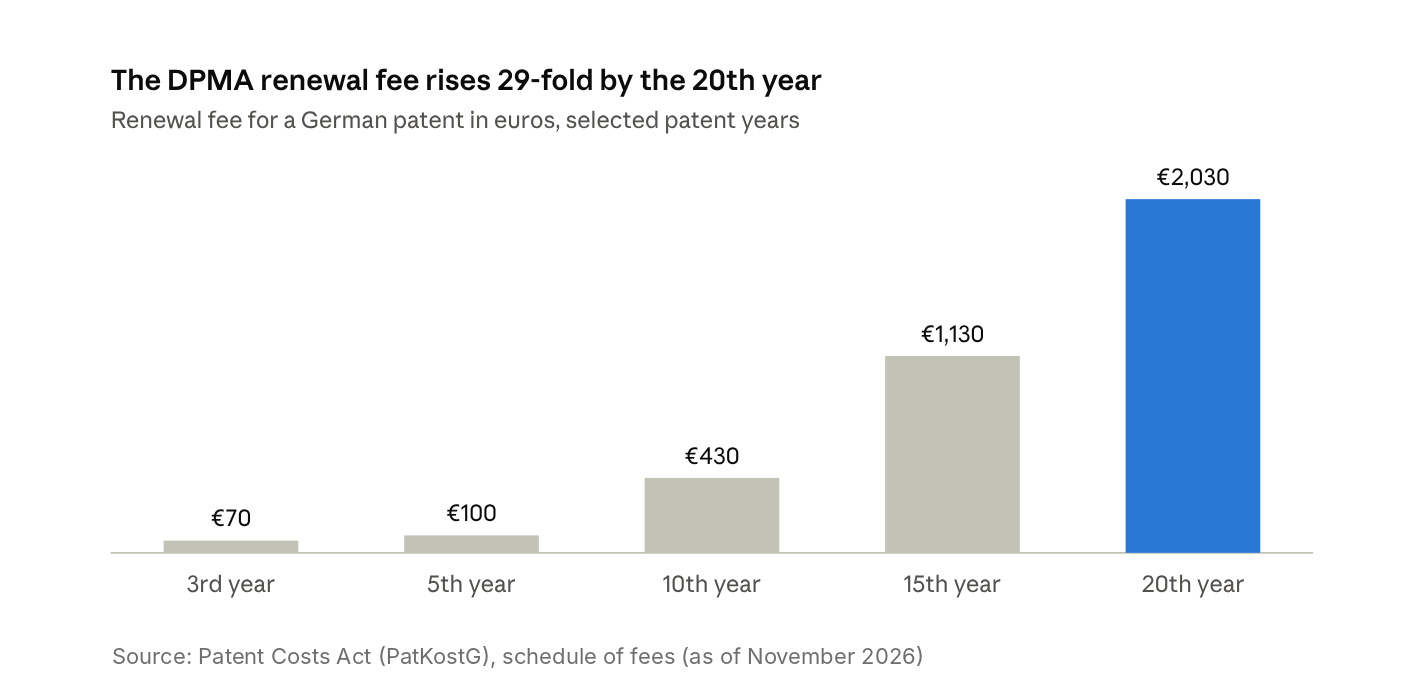
Anyone seeking protection in several countries pays such fee curves several times over. On top of that come translations and patent attorney costs at every stage.
Court costs: enforcement becomes a question of funds
A patent is only worth as much as its owner’s ability to enforce it. It is precisely this enforcement that became noticeably more expensive in 2025 and 2026.
In Germany, the cost law reform KostBRÄG 2025 has applied since 1 June 2025. Court fees rose by 6 to 9%, and lawyers’ fees under the Lawyers’ Remuneration Act (RVG) by 6% on average (Haufe). In patent infringement proceedings, the losing party also reimburses the costs of the opposing party’s patent attorney (Section 143(3) of the German Patent Act, PatG) – a considerable risk given typical amounts in dispute in the six- to seven-figure range.
At the Unified Patent Court (UPC), court fees rose even more sharply on 1 January 2026:
| UPC court fee | until 2025 | from 2026 | Increase |
|---|---|---|---|
| Infringement or revocation action (fixed fee) | €11,000 | €14,600 | +33% |
| Infringement action with a value in dispute of €2 million (total) | €24,000 | €31,800 | +33% |
| Appeal against a revocation decision (fixed fee) | €20,000 | €29,200 | +46% |
| Application to preserve evidence or for inspection | €350 | €5,000 | 14-fold |
Source: UPC table of court fees in the version applicable from 1 January 2026.
At the same time, the UPC now reimburses only 50% instead of 60% of the fees if an action is withdrawn early (Rule 370.9(b) of the Rules of Procedure, RoP). Small and micro-enterprises pay 60% of the fees (Rule 370.8 RoP; UPC FAQ on fees). But the absolute amount payable also grows with every increase – the next review has been announced for 2028.
Bureaucracy: the hidden levy on innovative companies
In proportional terms, bureaucracy burdens small innovative companies many times more heavily than large ones. The Institut für Mittelstandsforschung (IfM) Bonn measured this in 2025 for the mechanical and plant engineering sector on behalf of the IMPULS Foundation of the VDMA (idw, March 2025):
- The smallest company examined (150 employees, €35 million in revenue) bears €2.18 million in bureaucracy costs every year. That is 6.3% of revenue, or the salaries of 34 full-time employees.
- For the established companies, the figure is only 1.3% and 1.6% of revenue respectively.
- The average return on sales is 5.5%. For innovative companies, bureaucracy can therefore eat up the entire profit.
For the economy as a whole, the ifo Institute puts the consequences of bureaucracy at up to €146 billion in lost economic output per year. The National Regulatory Control Council (Normenkontrollrat) estimates the direct costs alone at €65 billion (ifo, November 2024).
For innovative companies, this is doubly bitter. Every hour spent on reporting and documentation obligations is missing from development and IP strategy. An earlier IfM study had already found bureaucracy costs of around 3% of revenue at innovative companies – roughly as much as small mechanical engineering firms spend on research and development.
The bill for innovative companies
IP costs are fixed costs: they are incurred regardless of how much revenue a company generates with the innovation.
A simplified worked example shows the order of magnitude. It assumes the average return on sales of 5.5% from the IfM study. Only official and court fees are included, without attorney, translation and validation costs:
| Cost item | Fee | Revenue required at a 5.5% return |
|---|---|---|
| UPC infringement action, value in dispute €2 million (court fees) | €31,800 | around €578,000 |
| Core EPO fees up to grant | €5,460 | around €99,000 |
| DPMA renewal fee in the 20th year | €2,030 | around €37,000 |
Three factors make the situation worse:
- The costs come before the revenue. Search and examination fall due long before a product is sold.
- The fees rise on schedule. The EPO and the UPC now review them every two years. Whether small suppliers can pass higher costs on to their customers is an open question.
- The litigation risk is asymmetrical. An established company with little innovation of its own can sit out proceedings. Anyone who cannot finance the action holds their patent only on paper.
What innovative companies can do now
The best remedy against rising costs is an IP strategy that considers costs and market opportunities together from the outset. Five levers are particularly effective:
- Use fee reductions. At the EPO, micro-enterprises (fewer than 10 employees, annual turnover or balance sheet total of up to €2 million), natural persons, universities, public research organisations and non-profit organisations have paid 30% less since 1 April 2024. This applies to filing, search, examination, designation, grant and renewal fees, provided the applicant has filed fewer than five patent applications in the preceding five years (EPO, European Patent Guide). The status must be expressly declared; where there are several applicants, each must meet the requirements. At the UPC, small and micro-enterprises pay 60% of the fees (Rule 370.8 RoP).
- Apply for funding. For SMEs filing for their first IP right in at least three years, the German federal programme WIPANO covers up to 50% of the costs, up to €10,000 in the filing module (IHK Stuttgart, PtJ). In 2026, the EU’s SME Fund also reimburses 75% of patent filing fees (up to €1,000) and 50% of attorney costs for European applications (up to €1,500) (DPMA). Whether programmes can be combined has to be checked in each individual case.
- Consider a utility model. Filing costs €30, and around €1,120 in official fees is incurred over the full term of ten years (Section 23(1) of the German Utility Model Act, GebrMG) (PatKostG). The utility model is registered quickly, but unexamined; processes are excluded from protection (Section 2 No. 3 GebrMG). For products with a short life cycle, it is often the more economical choice.
- Choose countries selectively. Protection pays off where products are manufactured, sold or copied. Whether a Unitary Patent or individual national validations are cheaper depends on the number of target markets.
- Review the portfolio regularly. Patents that no longer protect a relevant market are better allowed to lapse before the renewal fees rise steeply.
Conclusion
Whether or not one follows the thesis of a society’s late stage: the cost curve for innovative companies is measurably pointing upwards. EPO fees +5% in April 2026, UPC court fees +33% in January 2026, German court fees +6 to 9% since June 2025 – plus a bureaucratic burden that, proportionally, hits innovative companies hardest.
Innovative strength continues to pay off, but only with a strategy that ties every euro spent on IP rights to a market. Fee reductions and funding programmes offset part of the additional costs – if you know about them and apply in good time.
For innovative companies, it is therefore worth working through the numbers of their IP strategy at an early stage – including eligibility for funding, choice of countries and litigation cost risk.


