
Dacia calls it an innovation of its own; Dacia’s CEO calls it her customers’ most popular button: the “My Safety” button to the left of the steering wheel. Pressed twice, it switches off a selected bundle of driver assistance systems. Since the EU has made these systems mandatory for all new cars, together with their reactivation at every start, a question of comfort has become a selling point.
For patent attorneys, a more fundamental question arises. The button does not solve a problem that technology brought about, but one that the legislator created. Can such a solution be protected at the European Patent Office (EPO) – and if so, what exactly about it?
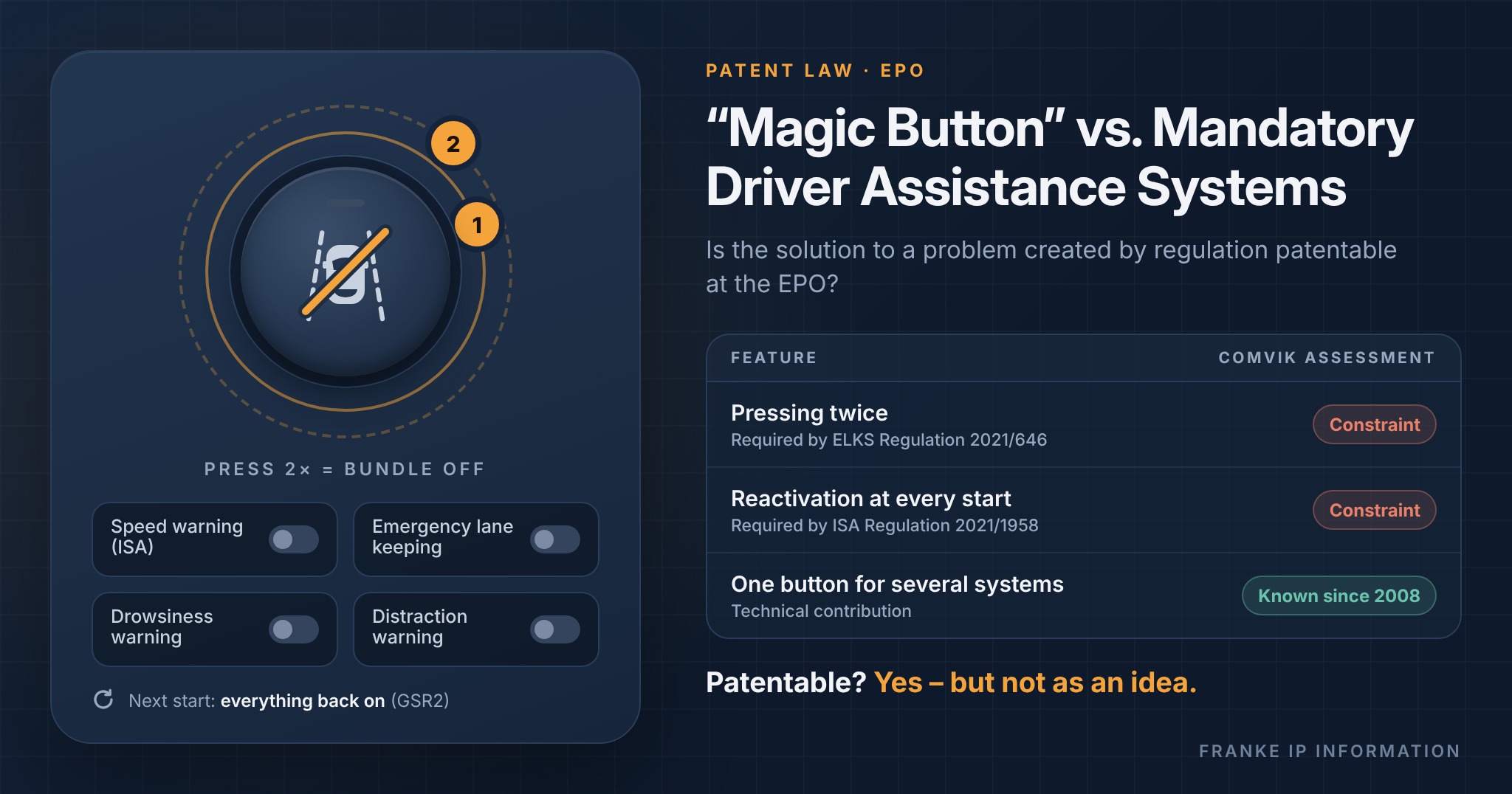
The short answer: In principle, yes. The EPO does not ask where a problem comes from, but whether the claimed solution is technical and involves an inventive step. That is precisely where the hurdle lies: under the COMVIK approach, what the regulator prescribes counts as a non-technical constraint and does not work in the applicant’s favour. What remains after that – a button that switches several assistance systems together – has been prior art for years. What is protectable is therefore not the “Magic Button” as an idea, but at most a concrete technical implementation that goes beyond the regulatory minimum.
I. The Occasion: The “My Safety” Button
The button does not switch off “all” assistance systems, but a bundle configured by the driver – and only until the next start. The function comes from the Renault Group’s modular toolkit. It can be found at Dacia, e.g. in the Sandero, Logan, Jogger, Duster and Spring, as well as at Renault, e.g. in the Clio, Captur, Mégane, Scénic, Renault 5, Master, Trafic and Kangoo. Dacia nevertheless describes “My Safety” as its own innovation.
According to the owner’s manuals (Renault 5, Dacia Duster), operation follows a simple pattern:
- “ALL ON”: default state. All systems in the bundle are active, and the button’s indicator light is on.
- “Perso”: pressing twice with the ignition on. After the first press, the instrument cluster prompts for the second (“Press again for My Safety Perso”); the light then goes out, and the selected systems are off.
- Back to “ALL ON”: a single press.
- Configuration: only when the vehicle is stationary, via the multimedia screen or the instrument cluster. The selection is saved when the vehicle is switched off or locked.
Depending on the model, the bundle comprises the acoustic speed warning, the lane keeping assist and the emergency lane keeping assist, the drowsiness and distraction warning, and the blind-spot warning. At the next start, the rule is again: “ALL ON”. In Renault vehicles, according to the manual, the warnings are reactivated as soon as the vehicle is unlocked or a door is opened.
Demand for these systems is high. According to Auto Bild, Dacia CEO Katrin Adt told the magazine Autocar that “My Safety” is the most popular feature among Dacia drivers. In January 2026, the French Ligue de défense des conducteurs ranked the Renault Group first in its comparison because two button presses are enough (see: Futura).
II. The Regulatory Framework: Why the Button Is Pressed Twice
Pressing twice is not a question of design, but the legal minimum. Since 7 July 2024, all newly registered passenger cars and light commercial vehicles in the EU must be fitted with the systems of Regulation (EU) 2019/2144 (“GSR2”), including ISA, ELKS, autonomous emergency braking and the drowsiness warning (Thatcham). Since 7 July 2026, the advanced driver distraction warning (ADDW) has been added for all new vehicles of categories M1 and N1 (Autohled).
The implementing rules govern not only what the systems must achieve, but also how the driver may switch them off:
| System | Legal basis | Manual deactivation | After a restart |
|---|---|---|---|
| Intelligent speed assistance (ISA) | Delegated Regulation (EU) 2021/1958, Annex I, point 3.2 | full or partial deactivation permitted, including a mute button for a single warning; constant optical signal when fully deactivated; reactivation with no more actions than deactivation | automatically reinstated in normal operation; may be made conditional on the driver’s door having been opened |
| Emergency lane keeping system (ELKS) | Implementing Regulation (EU) 2021/646 | full deactivation not possible with fewer than two deliberate actions, such as “press and hold” or “select and confirm”; acoustic warnings must be easy to suppress (ATIC) | automatically active again |
These requirements explain the Renault Group’s operating concept almost entirely:
- Two presses satisfy the ELKS requirement of two deliberate actions. Renault has placed the “select and confirm” variant on a single button.
- One press back satisfies the ISA requirement that reactivation must not be more cumbersome than deactivation (point 3.2.1.3).
- The repetition on every journey is not a weakness of the design, but an obligation (point 3.2.1.1).
Article 4 of the ISA Regulation is noteworthy. Under it, manufacturers report to the type-approval authorities what share of driving time or driving distance is covered with ISA switched on and switched off, and how long it takes on average until it is switched off. From 7 July 2024, the authorities forward these data to the Commission every six months for two years. The regulator is thus watching closely how often buttons of this kind are pressed.
III. How Other Manufacturers Solve the Problem
Manufacturers respond in very different ways: from a bundle button to up to 16 menu steps. We have summarised a comparison by the Ligue de défense des conducteurs (LDC) from January 2026 and further reports:
| Manufacturer | Solution | Operating effort according to source |
|---|---|---|
| Renault Group (Renault, Dacia) | physical “My Safety” bundle button with a profile configurable when stationary | 2 button presses (Futura/LDC) |
| Stellantis (Citroën, Peugeot) | according to a report (which names no model), a console button that switches off a pre-selected bundle after being held for about three seconds; Peugeot with a dedicated button for “multiple deactivation” (Génération NT) | Citroën: at most 4 steps (LDC) |
| Volkswagen Group | menu in the central display | at most 4 steps (LDC); ID.7: three taps (t-online) |
| Hyundai, Kia | freely assignable favourites button on the steering wheel, to which ISA deactivation can be assigned; Hyundai additionally with a purely visual warning level (regit, inFranken) | button plus selection |
| Volvo | dedicated ISA button on the steering wheel; the same button switches it back on (Volvo) | 1 button press, ISA only |
| Nissan | preferences stored in the instrument cluster, retrievable after each start via a steering-wheel button (regit) | shortcut button |
| BMW, Mercedes-Benz | menu paths in iDrive and in the instrument cluster, respectively (inFranken) | several steps |
| Suzuki, Toyota | menu, in some cases only when stationary | up to 15 or 16 steps (LDC) |
| Aftermarket suppliers (e.g. Cete Automotive) | plug-and-play module that carries the ISA muting over the restart (inside digital) | none; according to the assessment of a testing organisation, however, the vehicle’s operating permit lapses |
Behind this are five types of solution:
- Bundle button with profile (Renault Group, Stellantis): one button, one stored set of systems.
- Freely assignable favourites button (Hyundai, Kia, Nissan): deactivation is assigned to a button as one of several functions.
- Single button for one system (Volvo): direct, but only for ISA.
- Menu navigation (VW, BMW, Mercedes-Benz, Toyota, Suzuki): compliant, but cumbersome.
- Retrofit module (third parties): circumvents the reactivation and thus leaves the framework of type approval.
The pressure on car manufacturers is growing. Since 2026, Euro NCAP has also been assessing assistance systems in real traffic, explicitly in order to improve their acceptance (Euro NCAP). In addition, there are more points for physical buttons for frequently used functions (Rushlane). Competition for the most convenient compliant off switch is therefore likely to intensify, and with it the question of who can obtain protection for it.
IV. The Starting Point Under Patent Law at the EPO
1. The Origin of the Problem Is Irrelevant
The obvious objection runs as follows: a button that exists only because the legislator mandates certain systems does not solve a technical problem, but a legal one. However, the EPO does not examine how a need came about. It examines whether the claimed subject-matter has technical character and involves an inventive step over the prior art.
That regulation creates technical problems is the rule rather than the exception in vehicle engineering. Emission limits have given rise to an entire exhaust after-treatment industry; the obligation to emit a warning sound from quiet electric vehicles (AVAS) has created a new class of components. Nobody denies a catalytic converter technical character because the Euro standard first made it necessary.
A control element that switches a vehicle’s steering interventions and warning signals is likewise an invention within the meaning of Article 52(1) EPC – if only because it comprises technical means (T 258/03, Hitachi). The Magic Button therefore clears the first hurdle without difficulty.
2. The Real Hurdle: COMVIK
For subject-matter with technical and non-technical features, the EPO applies the COMVIK approach (T 641/00). Only features that contribute to the technical character can support an inventive step. Non-technical aims, by contrast, may be included in the objective technical problem as a constraint that is given to the skilled person (epi Information).
In T 1463/11 (CardinalCommerce), the Board coined for this purpose the figure of the notional business person who writes the requirements into the technician’s specification. In the case of Dacia’s “Magic Button”, the legislator takes this person’s place. Reactivation at every start, at least two deliberate actions, reactivation with no more actions: the skilled person receives all of this as a given. These features cannot establish an inventive step, even if they appear in the claim.
The EPO’s Guidelines for Examination say so explicitly for user interfaces: design features of a menu that are based on aesthetic considerations, subjective preferences or administrative rules do not contribute to the technical character (Guidelines G-II, 3.7.1). A type-approval requirement is such an administrative rule.
3. What Is Technical About the Control Element
Conversely, according to the same Guidelines, features that specify a mechanism for user input – such as making a selection or submitting a command – normally make a technical contribution. The Boards of Appeal have repeatedly recognised a reduction in the inputs required as a technical effect, for example in T 0200/19 with regard to the number of keystrokes.
The Boards draw limits in three cases:
- The advantage lies merely in a reduced cognitive burden on the user (T 1741/08, T 1802/13).
- A single input replaces several inputs, but is itself so complex that it places greater demands on the user (T 1098/20).
- The saving occurs only for certain usage patterns or depending on the user’s experience (Guidelines G-II, 3.7.1).
Reducing up to 16 menu steps to two button presses is objective and does not depend on the driver’s taste. It shortens the time during which the driver is distracted while driving, and it acts directly on control functions of the vehicle. The operating concept as such therefore contributes to the technical character – the only question is whether it is new and non-obvious.
V. The “Magic Button” in the Problem-Solution Approach
A claim reflecting the Renault solution would likely fail for lack of inventive step. This is shown by a hypothetical claim, broken down as an examiner would analyse it:
Vehicle with several driver assistance systems which are automatically activated each time the main switch is operated, and with a physical control element, wherein a set of the assistance systems that is configurable by the driver when the vehicle is stationary is stored, which set is jointly deactivated by actuating the control element twice and jointly reactivated by actuating it once.
1. Feature Analysis
| Feature | Origin | Contribution to the technical character |
|---|---|---|
| several assistance systems in the vehicle | prior art | technical, known |
| automatic activation at every start | ISA and ELKS requirement | regulatory constraint |
| one physical control element for several systems | design choice | technical input mechanism |
| driver-configurable, stored set | design choice | storage technical, but trivial; the selection itself is a user preference |
| configuration only when stationary | safety consideration | technical, obvious |
| deactivation by two actuations | ELKS requirement (two deliberate actions) | constraint under COMVIK |
| reactivation by one actuation | ISA requirement (point 3.2.1.3) | constraint under COMVIK |
| prompt in the instrument cluster (“Press again …”) | operator guidance | presentation of information, at most a weak contribution |
2. Objective Technical Problem
The problem could be framed roughly as follows: to provide an operating concept with which several assistance systems that are reactivated at every start can be switched off with as few operating actions as possible. The constraint is that switching off requires at least two deliberate actions and switching back on requires no more actions than switching off. The most striking features of the Renault solution are thus already part of the problem.
3. Prior Art
This problem is confronted with dense prior art. A cursory search reveals, among others:
- Volkswagen, WO 2009/149895 A1 (priority June 2008): driver assistance functions are bundled into “packages” whose content the driver can define via a menu; a first press of the SET button calls up a package, a second confirms it (US family member).
- GM, DE 20 2013 011 340 U1 (filed December 2013): device for setting assistance functions with a vehicle-side control element and a memory for selected settings.
- Daimler, DE 10 2015 002 248 A1 (February 2015): vehicle services are combined into groups and jointly activated or deactivated with a single action.
- BMW, US 11,235,764 B2 (priority April 2015): traffic jam assistant and lane guidance assistant are switched via a single common on/off button.
- The ELKS Regulation itself (OJ L 133, 20.4.2021): legal texts, too, are prior art under Article 54(2) EPC. With “select and confirm”, the Regulation already names the operating sequence that Renault places on one button.
In addition, there is common general knowledge. Confirmation prompts of the “press again” type and drive-mode selectors with an individually configurable mode have been widespread for years.
4. Result
Starting from the VW document, which already describes calling up and confirming an assistance package by pressing the same button twice, the skilled person essentially only has to implement the regulatory requirements. Confirmation by a second press is one of a few obvious options that the text of the regulation itself suggests. The claim thus fails not because the problem was caused by law, but because the solution makes do with known means.
Nor does the concept of a problem invention help. It is true that merely recognising a previously unknown problem can constitute an inventive achievement (T 2/83, Simethicone Tablet). Here, however, the problem was obvious to every manufacturer when GSR2 entered into force in July 2024 and was widely discussed in the trade press and by associations. Secondary indicators such as commercial success carry little weight either: such success rests on the legal situation, not on a non-obvious technical feature.
VI. Where the Protection Potential Actually Lies
Anyone wishing to file in this environment should look for the invention where the regulation is silent. Starting points are technical implementations that go beyond the regulatory minimum:
- State logic across ignition cycles. The ISA Regulation allows reactivation to be made conditional on the driver’s door being opened. How vehicle states such as a restart after stalling, start-stop or a change of driver are detected and plausibility-checked is a technical question.
- Robust detection of “deliberate actions”. Time windows, debouncing, a comparison with the vehicle state or hand-on-button detection can rule out unintentional double actuations.
- Distributed implementation in the vehicle network. A button that switches systems on several control units must ensure a consistent state, an acknowledgement and a defined behaviour in the event of a fault. This is classic control engineering.
- Situation-dependent reactivation. With EP 4 101 713 A1, Volvo Truck has filed a method that records the road condition at the time of deactivation, such as lane width, curvature or roadworks. When this condition ends, the lane keeping assist switches itself back on. Such sensor-based logic has a considerably better starting position than any button combination.
- Adapting instead of switching off. From 2026, Euro NCAP takes into account lane keeping systems that adapt in real time to the driver’s attention and distraction (AB Dynamics). Whoever technically eliminates the reason for switching off, rather than making switching off easier, keeps a greater distance from the prior art.
Notes on Filing
- Describe the technical effect objectively. Fewer operating actions, shorter distraction, a consistent system state – irrespective of which systems a particular driver wishes to switch off (Guidelines G-II, 3.7.1).
- Explain the legal framework, but do not build on it. It justifies the problem, but it does not carry the solution.
- Build in fallback positions. Concrete implementation features such as time windows, bus architecture, state memory or door contact belong in the description and in dependent claims.
- Read the regulation as prior art. What it gives as an example is no longer new.
VII. When the Framework Shifts Again
A patent on a solution that is needed only under a particular legal situation is a bet on that situation continuing. The patent runs for up to 20 years; the regulatory situation on which the Magic Button rests is considerably more short-lived. According to the European Transport Safety Council, GSR2 is due for review in 2027 (ETSC).
How quickly the framework moves is shown by the Automotive Omnibus package proposed in December 2025. Among other things, it provides for a new sub-category M1E for small electric cars, for which, as intended by the Commission, new safety requirements are to be frozen for ten years (ETSC; EPRS). According to these overviews, it does not change the deactivation rules for ISA and ELKS.
If the legislator in future allows the driver’s choice to be stored beyond a restart, the button loses its raison d’être. If the legislator tightens the requirements, the button’s value increases. The reporting obligations under Article 4 of the ISA Regulation provide the legislator with the data for either direction.
Conversely, the unlawfulness of a solution does not stand in the way of its patenting. Under Article 53(a) EPC, the exploitation of an invention is not deemed contrary to “ordre public” merely because it is prohibited by law in some or all of the Contracting States. Even a retrofit module that circumvents the mandatory reactivation would therefore not be excluded from patent protection for that reason alone. In any case, a patent confers only a right to exclude others, not a right to use (see our article “Patent-Irrtümer, die man besser kennen sollte” [Patent misconceptions you should be aware of], in German).
VIII. Conclusion
- The origin of a problem is irrelevant to the EPO. Even a problem that only arises from a shift in the legal framework can be a technical problem – from the catalytic converter to the warning sound for electric cars.
- What the regulator prescribes does not support an inventive step. Under COMVIK, it becomes a constraint of the problem. In the case of the Magic Button, this affects precisely the most striking features: pressing twice and reactivation at every start.
- The remaining technical core is old. A button that jointly switches several assistance systems with a stored profile has been prior art since 2008 at the latest. The actual technical problem – fewer operating actions – is real but simple, and it is solved with known means.
- Patentable, yes – but not as an idea. There are prospects for concrete technical implementations beyond the regulatory minimum, such as sensor-based reactivation, robust state logic or adaptive systems.
- The regulation is both a specification and prior art. Applicants should read it that way – and measure the value of the IP right against the expected lifetime of the legal situation.


