“Plurality” is one of the most common words in patent claims. German claims say “Vielzahl”, Japanese claims “複数” (fukusū). Yet infringement proceedings keep returning to the same question: how many elements make a plurality? Are two enough, must there be more than two, or does the word even imply a “large number”? We have reviewed the case law in Germany, before the Unified Patent Court (UPC), at the European Patent Office (EPO), in the United States and in Japan.
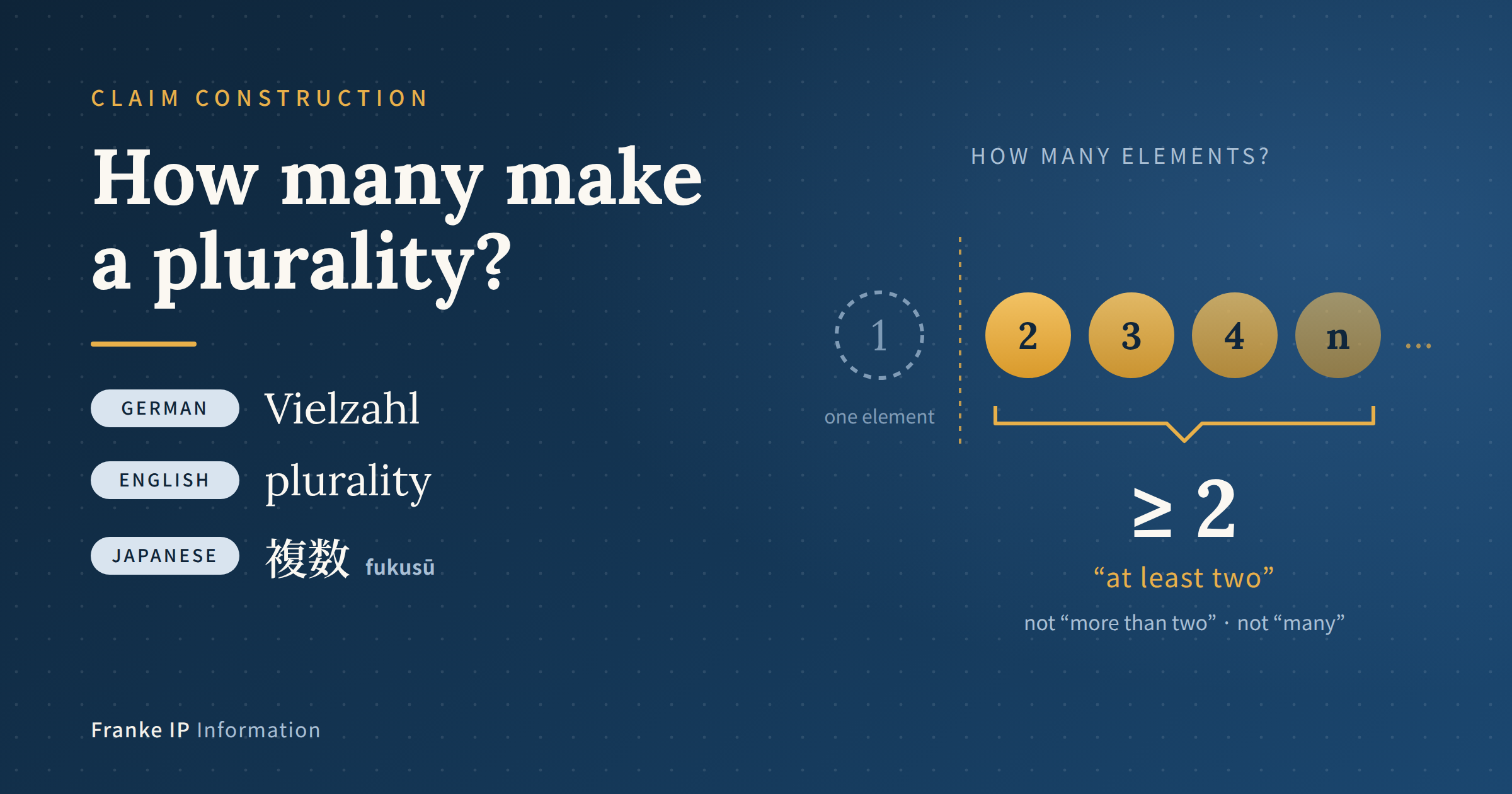
The short answer: As far as we can see, “Vielzahl”, “plurality” and “複数” mean “at least two” in every jurisdiction reviewed. That is “more than one”, not “more than two”, and certainly not “many”.
Deviating readings do occur, mostly as a defence argument. They have required at least three, or even more than three, elements. None of them prevailed in the decisions we reviewed. The term is still treacherous elsewhere: in lists, in the relationship between singular and plural, and in translation.
I. The starting point: “Vielzahl” is linguistically ambiguous
In everyday German, “Vielzahl” suggests a large quantity. Someone who speaks of a “Vielzahl von Beschwerden” (a multitude of complaints) rarely means exactly two. The English “plurality” is more sober and initially denotes nothing more than the state of being plural. The Japanese “複数” is the grammatical counterpart of “単数” (singular) and means “two or more”.
Claim construction, however, does not turn on everyday usage. What matters is how the skilled person understands the term against the background of the patent specification. The question is therefore whether courts treat “plurality” as a term of art in patent language, and whether they have ever arrived at a minimum number other than two.
II. Germany
1. Principles
According to settled case law of the Federal Court of Justice (BGH), a patent claim is to be construed from the perspective of the skilled person. The description and drawings must be taken into account, and the patent specification may serve as its “own dictionary”. A term can therefore have a meaning in the patent that differs from ordinary usage. This also applies to terms of quantity.
2. Case law on “Vielzahl”
The Düsseldorf patent chambers regularly construe “Vielzahl” as “at least two” without much discussion:
- Düsseldorf Regional Court, judgment of 12 December 2018 – 4b O 15/17: The claim concerned a “multiple decoding step” using a “Vielzahl von Dekodierungsverfahren” (plurality of decoding methods). The chamber held that “multiple” or “plurality” means “at least two” in this context. Two different decoding methods in the standard at issue were sufficient.
- Düsseldorf Regional Court, judgment of 24 April 2012 – 4b O 274/10: According to this decision, a “Vielzahl von Nutzerklassen” (plurality of user classes) requires a network in which “several”, i.e. at least two, user classes are distinguished.
- Düsseldorf Regional Court, judgment of 8 August 2019 – 4c O 88/17: A “Vielzahl von Probenverarbeitungs-Modulen” (plurality of sample processing modules) requires at least two modules. The chamber also derived this from the function: the claimed coordination only makes sense where there are several modules.
What is missing is also telling. In numerous other infringement cases the claim contained a “Vielzahl” without the parties raising the term at all. Examples are Düsseldorf Higher Regional Court, 2 U 72/23 (“plurality of cutting edges”), and Düsseldorf Higher Regional Court, 2 U 138/22 (“plurality of … dispensing mechanisms”). We found no published decision in which a German court considered “Vielzahl” unclear or required a minimum of more than two.
3. The reverse case: the plural as a generic term
In Germany, the deviation tends to go in the opposite direction. The Karlsruhe Higher Regional Court (judgment of 28 February 2024 – 6 U 161/22, “Magnetsteuerventil”) held that a plural used in a claim (“verbindende Wasserleitungen”, connecting water lines) can be understood as a generic designation. In that case a single element suffices. This applies at least where the patent as a whole does not show that at least two must be present.
For “Vielzahl” this argument is considerably harder to make. Unlike a mere plural, the word expressly denotes a number. The decision nevertheless shows that German courts always read quantities in the context of the patent specification and not purely grammatically.
III. Unified Patent Court
The UPC construes claims according to the principles set out by the Court of Appeal in NanoString v 10x Genomics (order of 26 February 2024). The claim is the decisive basis, and the description and drawings must always be used as explanatory aids. The first decisions on terms of quantity are now available:
- Local Division Düsseldorf, decision of 10 October 2024 – UPC_CFI_363/2023 (Seoul Viosys v expert): The claim required “mesa-etched regions” in the plural. The division held that this means at least two such regions.
- Local Division Milan, decision of 21 April 2026 – UPC_CFI_472/2024 et al. (Dainese v Alpinestars): The defendants argued that the claim did not require a “plurality of housings”. Elsewhere it referred to “one or more inner housings”, they said, and this contradiction made the (amended) claim unclear. The division disagreed. The skilled person would recognise that a plurality of housings is necessary for the invention to work, and all figures showed this structure. The patent was upheld and infringement was found.
The Milan case illustrates a typical risk. Using both “one or more” and “plurality” for the same element creates a point of attack. The courts resolve such tensions functionally, but not necessarily in the patentee’s favour.
IV. European Patent Office and United Kingdom
Following the Enlarged Board of Appeal’s decision G 1/24 (18 June 2025), the description and drawings must always be consulted when interpreting the claims, including when assessing patentability. The EPO has thereby moved closer to the UPC standard. For “plurality” this means that the EPO, too, reads the term in the light of the description. The description can therefore also define it with binding effect.
We found no Board of Appeal decision giving “plurality” a meaning other than “at least two” or objecting to the term as unclear under Art. 84 EPC. The same applies to the courts of England and Wales. They construe claims purposively and apply the equivalents approach of Actavis v Eli Lilly (UKSC 2017). Neither principle gives any reason to read in a “large number”.
V. United States
The position is clearest in the US, because the Federal Circuit has construed the term expressly on several occasions. This is also where the most striking examples of deviating readings can be found.
1. “Plurality” means “at least two”
- York Products v. Central Tractor Farm & Family Center, 99 F.3d 1568 (Fed. Cir. 1996): The district court had construed “plurality” as more than three gaps or pockets on each sidewall. The Federal Circuit reversed. The term means simply “the state of being plural” and therefore requires only at least two ridge members on each sidewall.
- Dayco Products v. Total Containment, 258 F.3d 1317 (Fed. Cir. 2001): The defendant argued that “plurality” required three or more projections. The court held instead that “plurality”, when used in a claim, refers to two or more items, “absent some indication to the contrary”.
- Callpod v. GN Netcom (N.D. Ill., 6 March 2009): The defendants argued that a “plurality of participants” in a conference call required at least three participants, because a conference presupposes more than two people. The court rejected this and held to “more than one”.
The phrase “absent some indication to the contrary” matters. In the US, too, “at least two” is only the default meaning. A different definition in the description or an unambiguous context may lead to another result.
2. Where “plurality” really does work differently
- Lists – SIMO Holdings v. Hong Kong uCloudlink, 983 F.3d 1367 (Fed. Cir. 2021): The claim required “a plurality of memory, processors, programs, communication circuitry, authentication data … and non-local calls database”. The Federal Circuit applied “a plurality of” to each item in the list, so that at least two of every item had to be present. Because the accused product lacked two databases, infringement was denied and a jury verdict of around USD 8 million was reversed. This is the most consequential “different meaning” of “plurality” in practice, although it concerns the reach of the term rather than the minimum number.
- Parts of a whole – August Technology v. Camtek (Fed. Cir. 2011): A “plurality of wafers” cannot be satisfied by counting sections of a single wafer as several wafers. The claim deliberately distinguished between “wafer” and “wafers”.
- A plural is not “one or more” – Apple v. MPH Technologies (Fed. Cir., 9 March 2022): Apple sought to read the plural “information fields” as “one or more”. The Federal Circuit required more than one field.
3. The counterpart: the indefinite article
Conversely, under US law the indefinite article “a” in open (“comprising”) claims generally means “one or more” (KCJ Corp. v. Kinetic Concepts, 2000). In Salazar v. AT&T Mobility (Fed. Cir., 5 April 2023), the Federal Circuit confirmed this rule but refined it. Where several functions are assigned to “said microprocessor”, at least one microprocessor must be capable of performing all of them. Spreading the functions across different processors is not enough.
VI. Japan
Under Art. 70(1) of the Japanese Patent Act, the technical scope of a patented invention is determined by the claims. Under Art. 70(2), the meaning of claim terms is to be interpreted in the light of the description and drawings. The courts also take into account the prosecution history, the prior art and common general knowledge.
“複数” means “two or more”, both linguistically and in patent practice. Japanese commentators regard the term as unproblematic for precisely this reason: writing “複数の” covers every case from two upwards, leaving no room for dispute. We found no published decision in which a Japanese court gave “複数” a different meaning. This is subject to the caveat that the Japanese case-law database was only partly searchable for us.
Indefinite quantity words are a different matter. The Japan Patent Office documents decisions in which expressions such as “わずかに” (slightly) or “適度に” (moderately) were held unclear where the description provided no yardstick. Practitioners therefore advise using the neutral “複数” rather than the evaluative “多数” (many, a large number).
The real risk in Japan lies in translation. Japanese nouns have no grammatical number. Without an additional marker, the Japanese text barely reveals whether an English claim said “a tank” or “tanks”. “One or more” or “at least one” should therefore be rendered expressly as “1つ以上の” or “少なくとも1つの”, and “a plurality of” as “複数の”.
A note on China: How seriously questions of number are taken in Asia is shown by a decision of the Supreme People’s Court of 13 November 2014 ((2014) Min Ti Zi No. 497, Free Motion Fitness). There, the express singular “one cable” was limited to exactly one cable despite the open wording of the claim.
VII. Overview
| Jurisdiction | Default meaning | Deviating approaches | Outcome |
|---|---|---|---|
| Germany | “Vielzahl” = at least two | A plural can, as a generic term, cover a single element (OLG Karlsruhe 2024) | No decision found requiring more than two or finding the term unclear |
| UPC | Plural = at least two | Objection that “one or more” contradicts “plurality” (LD Milan 2026) | Objection rejected; functional construction |
| EPO / UK | At least two; no deviating case law found (EPO: construction with the description under G 1/24) | — | No deviating decision found |
| US | “two or more … absent some indication to the contrary” | “More than three” (district court in York), “three or more” (defendants in Dayco, Callpod); applies to each list item (SIMO) | Minimum of two settled; SIMO narrows scope for lists |
| Japan | “複数” = two or more | — | No deviating decision found; risk lies in translation |
VIII. Drafting recommendations
- Define the term. One sentence in the description rules out the debate, for example: “For the purposes of this application, a plurality means a number of at least two.” (In German: „Unter einer Vielzahl bzw. mehreren wird im Sinne dieser Anmeldung eine Anzahl von mindestens zwei verstanden.“) Since G 1/24 and the UPC case law require the description always to be consulted, such a definition is effective both before the EPO and in infringement proceedings.
- Take care with lists. “A plurality of A, B and C” may be read as “at least two A, two B and two C” (SIMO). If only A is to be present more than once, “a plurality of A; a B; and a C” is the safe wording.
- Do not mix. Do not use “one or more” and “plurality” for the same element (cf. LD Milan).
- If one element is enough, say so. Write “at least one”, “one or more” or “1つ以上の”. Do not rely on the German case law on generic plurals.
- If more than two are needed, say that too. If the function requires at least three elements, “at least three” belongs in the claim. Courts do not derive a higher minimum from “plurality” alone.
- Check translations. In Japanese and Chinese, number must be stated expressly. Avoid evaluative quantity words such as “多数” (“many”).
IX. Conclusion
- “Vielzahl”, “plurality” and “複数” mean “at least two” in Germany, before the UPC, in the US and in Japan, not “more than two”. No deviating case law is apparent for the EPO or the United Kingdom.
- Readings requiring at least three, or more than three, elements appear mainly as defence arguments. They did not prevail in the decisions reviewed. The clearest correction was of the district court in York Products, which had required “more than three”.
- We found no decision holding “Vielzahl” or “plurality” to be unclear.
- The real risks lie elsewhere: in lists (SIMO), in the relationship between singular, plural and “one or more”, and in translation into languages without grammatical number.
- A short definition in the description costs nothing and takes an argument away from the other side.
Research status: September 2026. This overview is based on freely accessible decisions and publications. Subscription databases were not searched.
Sources
- Düsseldorf Regional Court (LG Düsseldorf), judgment of 12 December 2018 – 4b O 15/17, NRWE
- Düsseldorf Regional Court, judgment of 24 April 2012 – 4b O 274/10, NRWE
- Düsseldorf Regional Court, judgment of 8 August 2019 – 4c O 88/17, NRWE
- Düsseldorf Higher Regional Court (OLG Düsseldorf), judgment of 4 April 2024 – 2 U 72/23, NRWE; judgment of 23 November 2023 – 2 U 138/22, NRWE
- Karlsruhe Higher Regional Court (OLG Karlsruhe), judgment of 28 February 2024 – 6 U 161/22 (Magnetsteuerventil), commentary: CBH Rechtsanwälte (German)
- UPC, Local Division Düsseldorf, decision of 10 October 2024 – UPC_CFI_363/2023 (Seoul Viosys v expert), UPC
- UPC, Local Division Milan, decision of 21 April 2026 – UPC_CFI_472/2024 et al. (Dainese v Alpinestars), UPC
- EPO, Enlarged Board of Appeal, G 1/24 of 18 June 2025, overview: J A Kemp
- York Products v. Central Tractor Farm & Family Center, 99 F.3d 1568 (Fed. Cir. 1996), FindLaw
- Dayco Products v. Total Containment, 258 F.3d 1317 (Fed. Cir. 2001), CourtListener
- Callpod v. GN Netcom (N.D. Ill. 2009), commentary: Chicago IP Litigation
- SIMO Holdings v. Hong Kong uCloudlink, 983 F.3d 1367 (Fed. Cir. 2021), CAFC; commentary: Cantor Colburn
- August Technology v. Camtek (Fed. Cir. 2011), commentary: Lexology
- Apple v. MPH Technologies (Fed. Cir. 2022), commentary: IP Update
- Salazar v. AT&T Mobility (Fed. Cir. 2023), CAFC
- WIPO, Patent Judicial Guide – Japan, ch. 7.5 (claim construction, Art. 70 Japanese Patent Act), WIPO
- JPAA, パテント 2015/4, “日英翻訳における数と冠詞の概念” (number and articles in Japanese–English translation), PDF (Japanese)
- JPO, 記載要件に関する裁判例 (court decisions on indefinite expressions), PDF (Japanese)
- JIII, 請求項における単数・複数の記載が権利範囲解釈に与える影響 (2015, on the Chinese SPC decision of 2014)